Above the Arctic Circle
Exploring Abisko National Park in Swedish Lapland in both Summer and Winter
Sweden is a long, slender country stretching roughly 1,600 kilometers from north to south. Its geography makes for striking contrasts in climate and landscape. In the south lies Skåne, with its rolling fields of golden rapeseed that glow during the brief warmth of summer. Along the west coast, Gothenburg and its archipelago invite Swedes to their summer houses, while a bit further north you’ll find Fjällbacka, a charming coastal town that has set the scene for many Scandinavian crime thrillers. So far, the picture is one of a mild, forgiving Swedish summer. But this blog post is about quite the opposite. We’re taking you far north, about 200 kilometers above the Arctic Circle, to a region commonly known as Swedish Lapland. It is bounded by the giant glaciers and fjords of Norway in the west and the conifers and lakes of Finland in the east. Specifally, to a small town and its beautiful surrounding landscapes, namely Abisko. Here, summer is fleeting but unforgettable. Long daylight hours turn it into a hiker’s paradise, and as the days shorten, birch forests turn into gorgeous golden glow before giving way to the inevitable, icy grip of winter. Yet winter in Abisko is far from desolate. It’s one of the world’s best places to see the northern lights and in addition offers a plethora of activities. And despite the cold, it’s not all darkness as the long twilight hours then bathe the Arctic landscape in a soft, magical light.
Before diving into the details of our adventures around Abisko throughout the seasons, here’s a quick overview to help you navigate the post and skip directly to the sections that interest you the most.
Overview
Itinerary | Planning | Recommendations | Conclusion | Links | Map
Itinerary
Since we visited Abisko (Northern Sami: Ábeskovvu) twice – once in late summer and once in the height of winter – this itinerary is structured a bit differently from the usual day-by-day breakdowns. Instead of a strict schedule, this section gives an overview of what the warmer and colder months have to offer and how you might structure your own trip.
Abisko in Summer
Our first trip to Abisko was in early September. Given how short the growing season is this far north, this already marks the transition into autumn – more on that later though.
To get there, we took the overnight train (more details on that in the planning section) and got off not at the main Abisko station, Abisko Östra (east), but at the Abisko Turiststation stop, about 4 km further west. Don’t let the fact that Abisko has two train stations fool you into thinking it’s a large town. It has fewer than 100 inhabitants and is quite spread out. However, the STF Turiststation and Abisko National Park bring enough visitors to justify their own dedicated stop (STF stands for the Swedish Tourist Association).
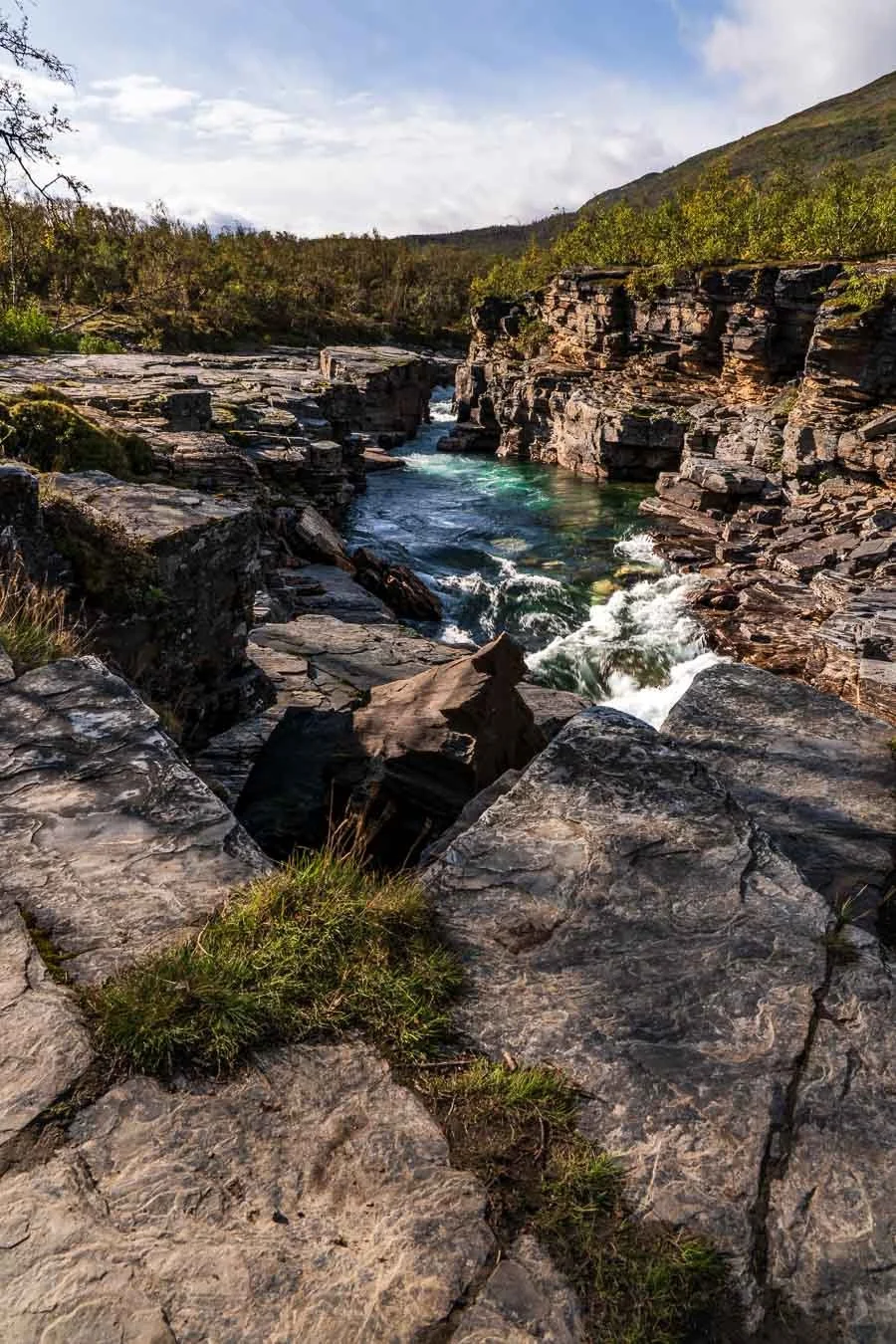
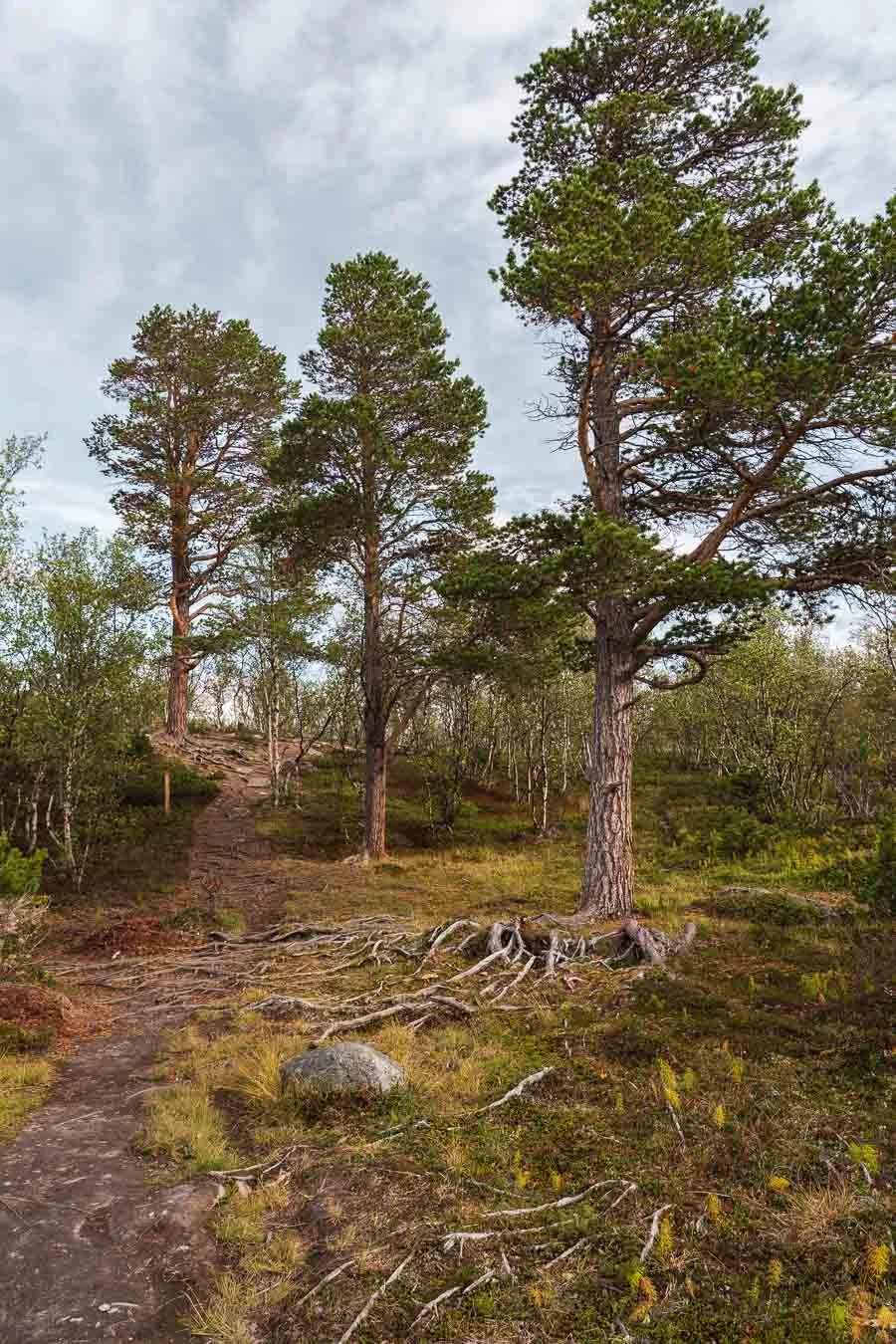
Abisko National Park is one of Sweden’s most iconic protected areas. It covers around 77 square kilometers and is home to mountains, open valleys, alpine lakes, and, in the warmer months, a surprising abundance of wildflowers. One of its defining features is the dominance of birch trees, which turn a brilliant golden yellow in autumn. All of this makes Abisko National Park an excellent place to hike. There are several day hikes starting near the STF Turiststation, such as the Njakajaure nature trail, the path along the Abiskojåkka canyon, the hike along the Abiskojåkka down to the shores of Lake Torneträsk, or the route up towards Nuolja (Nuolja summit or Aurora Sky Station area).
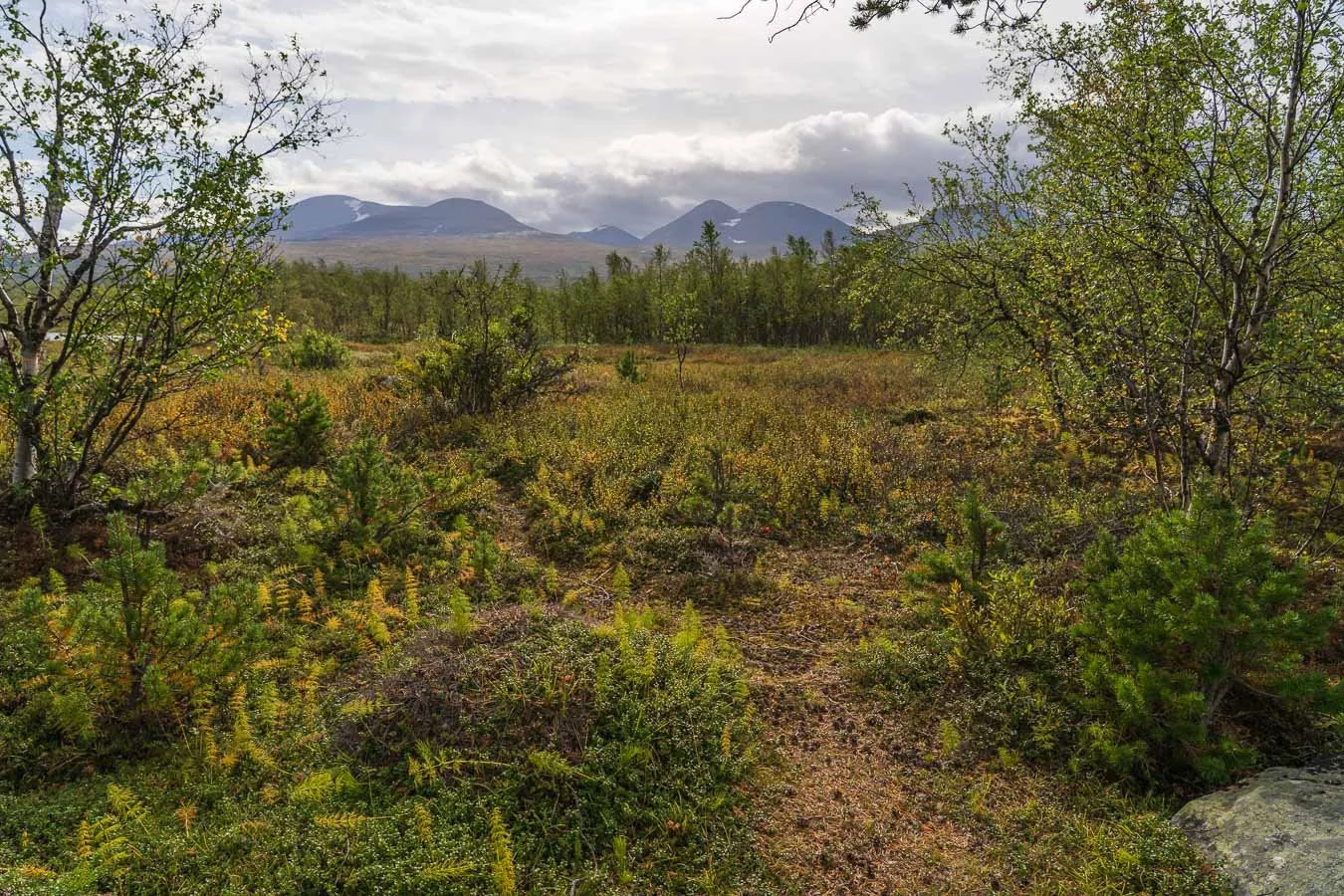
That, however, was not the main reason we came all the way north. Abisko and Abisko National Park form a key section of the Kungsleden (‘King’s Trail’), one of Sweden’s – and arguably Europe’s – most famous long-distance hiking routes. The full trail is about 460 km long and runs between Abisko in the north and Hemavan in the south. Hiking the entire route takes roughly a month and a healthy amount of determination, so most people choose one of the five main sections.
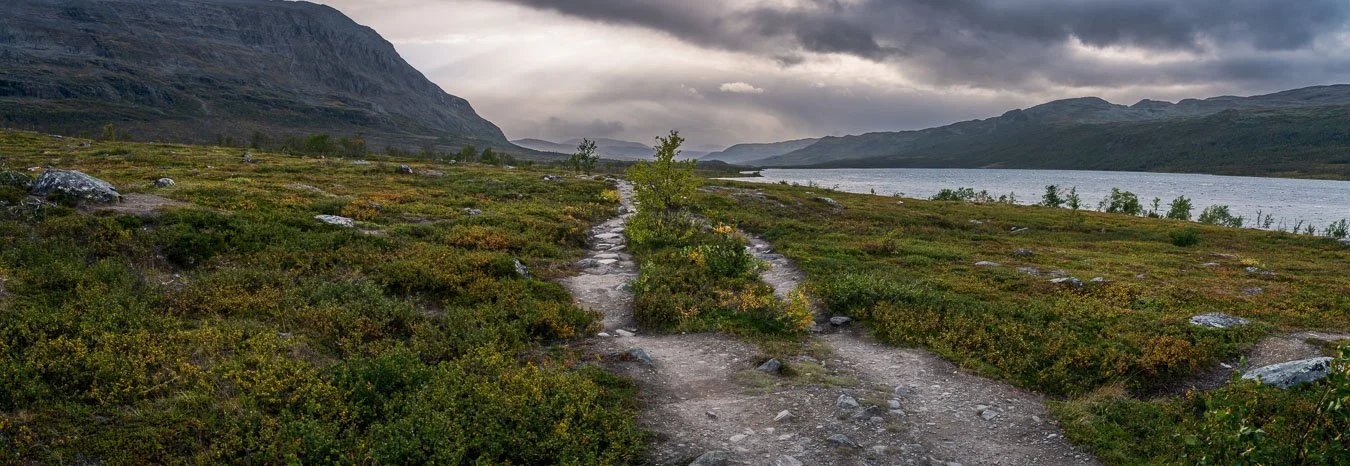
Section of the Kungsleden trail along Lake Abiskojaure, shortly before reaching the STF Abiskojaure campsite.
The section from Abisko to Nikkaluokta, passing near Sweden’s highest mountain, Kebnekaise, is particularly popular. It combines manageable distances with varied, mountainous scenery. The stretch is about 107 km and typically takes around 6–9 days, depending on how you break it up.
A typical itinerary might look like this:
Abisko – Abiskojaure, 15 km (450 m elevation gain)
Abiskojaure – Alesjaure, 20 km (619 m elevation gain)
Alesjaure – Tjäktja, 13 km (470 m elevation gain)
Tjäktja – Sälka, 12 km (218 m elevation gain)
Sälka – Singi, 12 km (215 m elevation gain)
Singi – Kebnekaise, 14 km (317 m elevation gain)
Kebnekaise – Nikkaluokta, 19 km (228 m elevation gain)
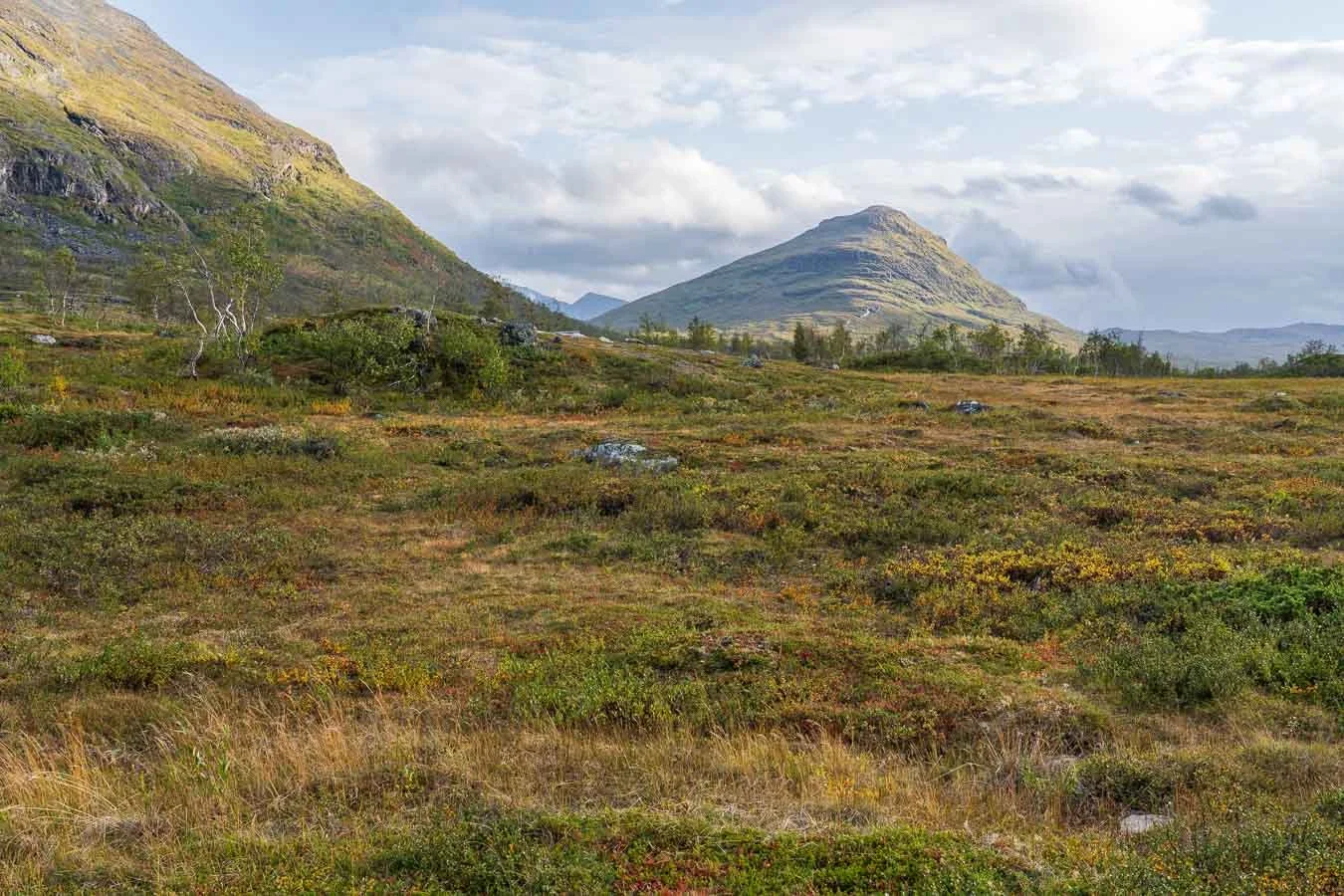
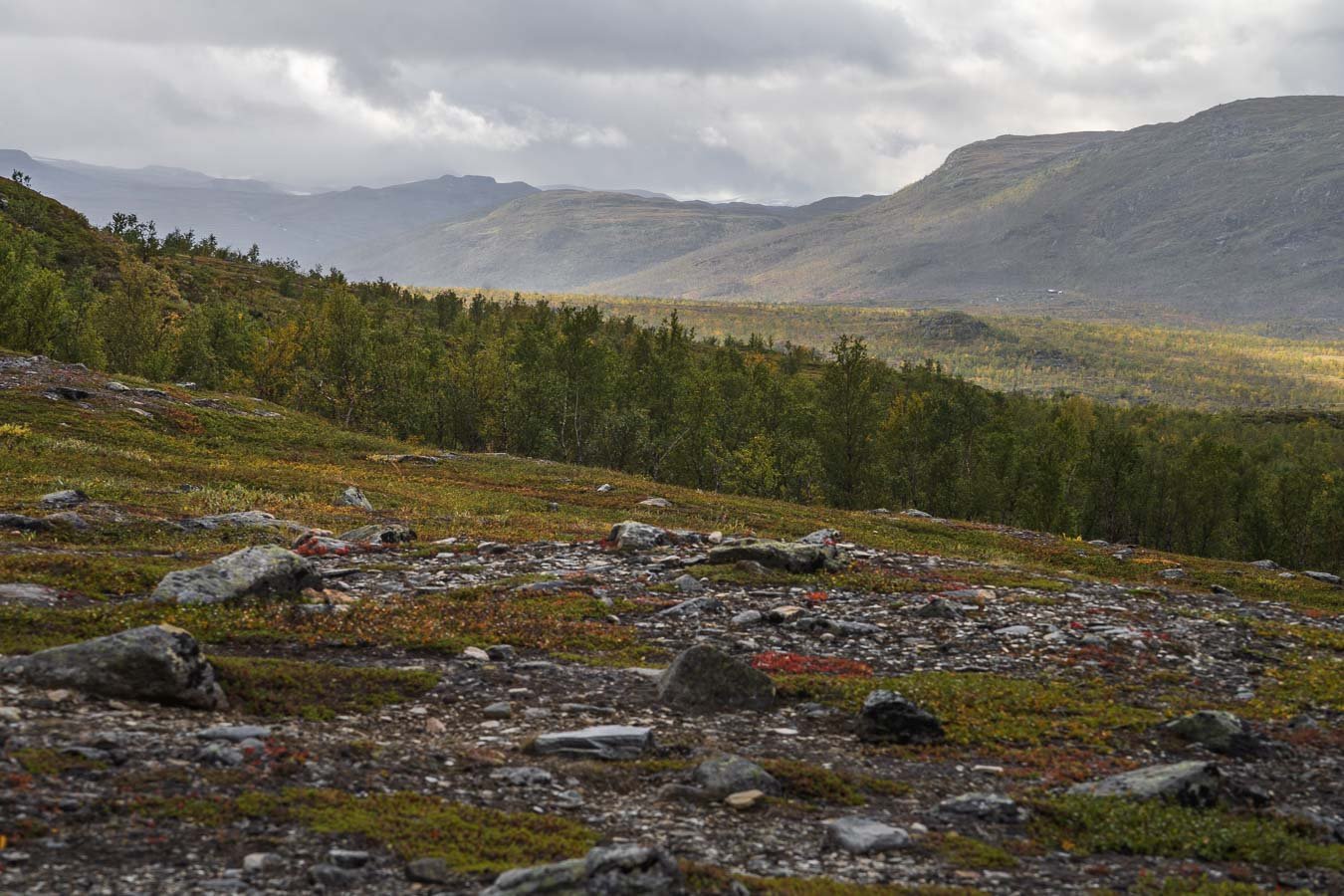
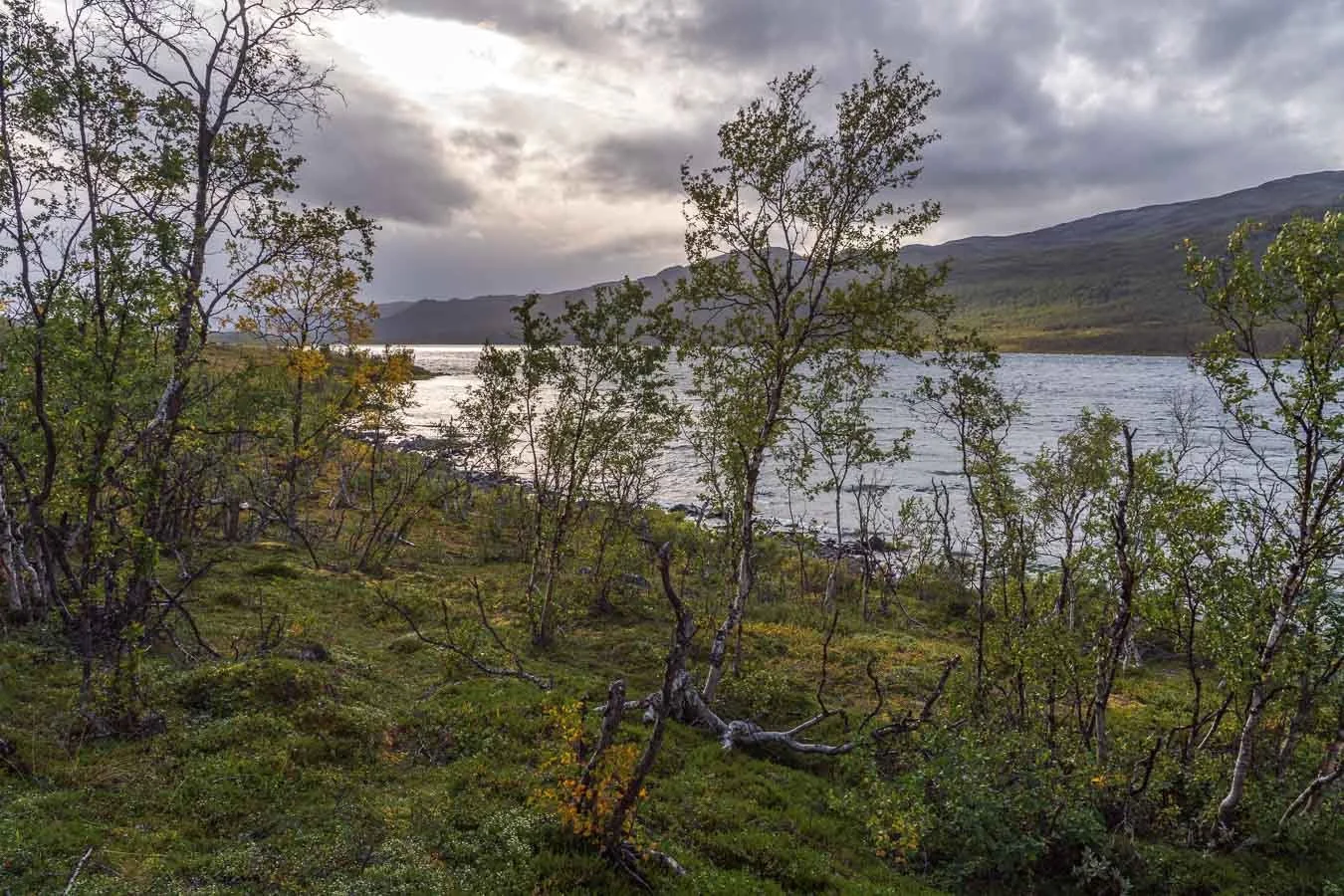
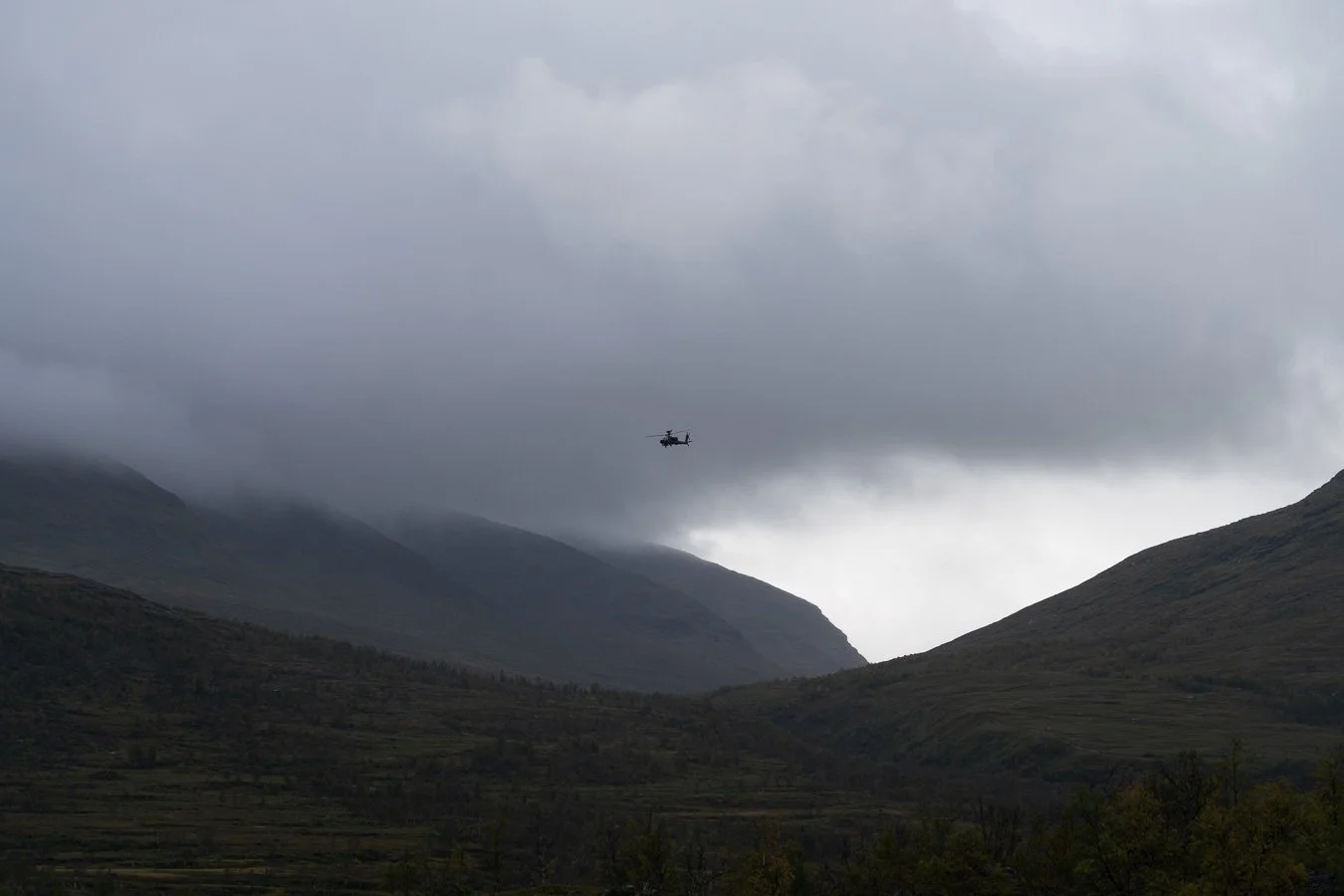
Outside of the northernmost stretch through Abisko National Park, wild camping is permitted (when following the standard constraints), giving you flexibility to adapt to bad weather, stop at especially scenic spots, or simply rest when needed.
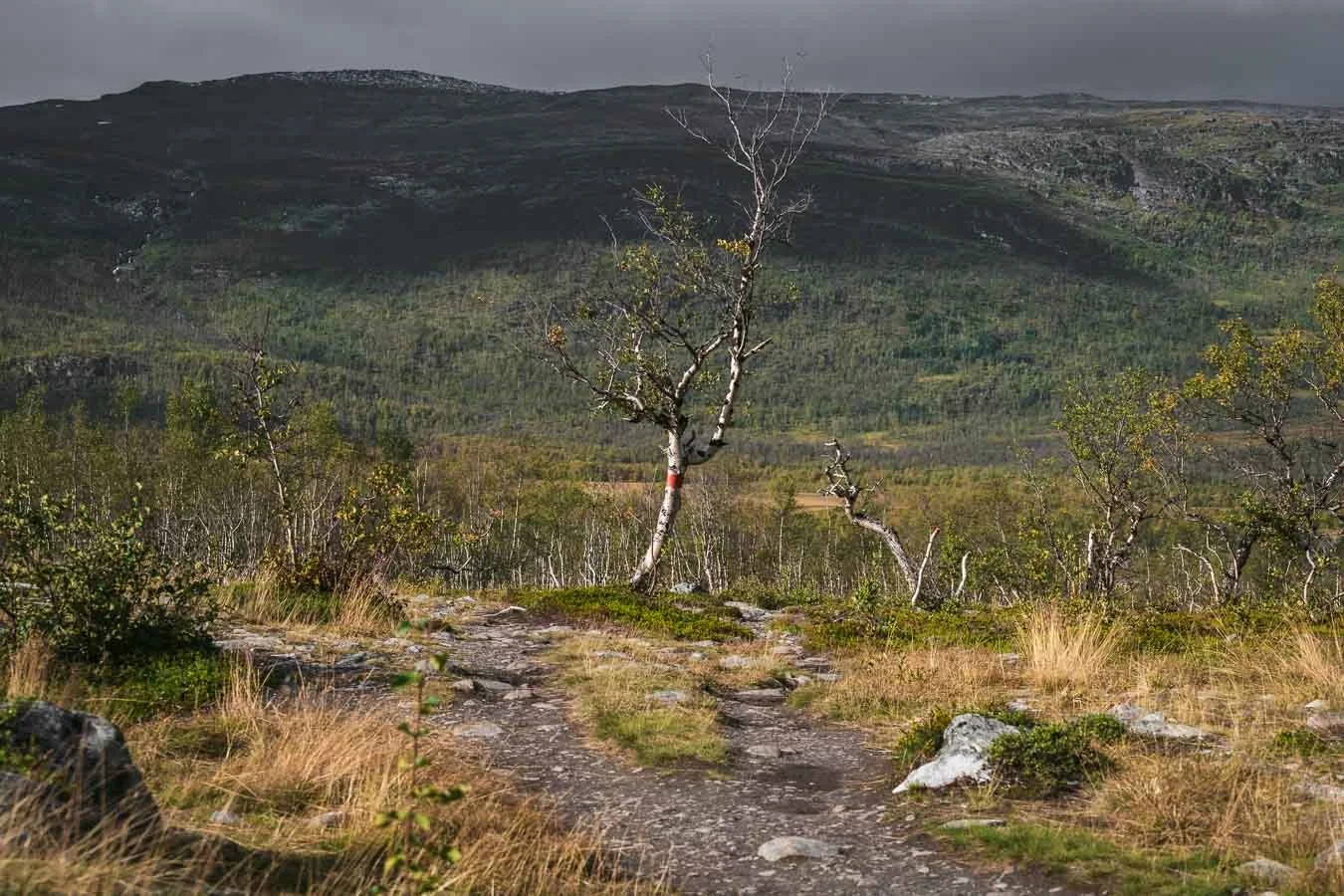
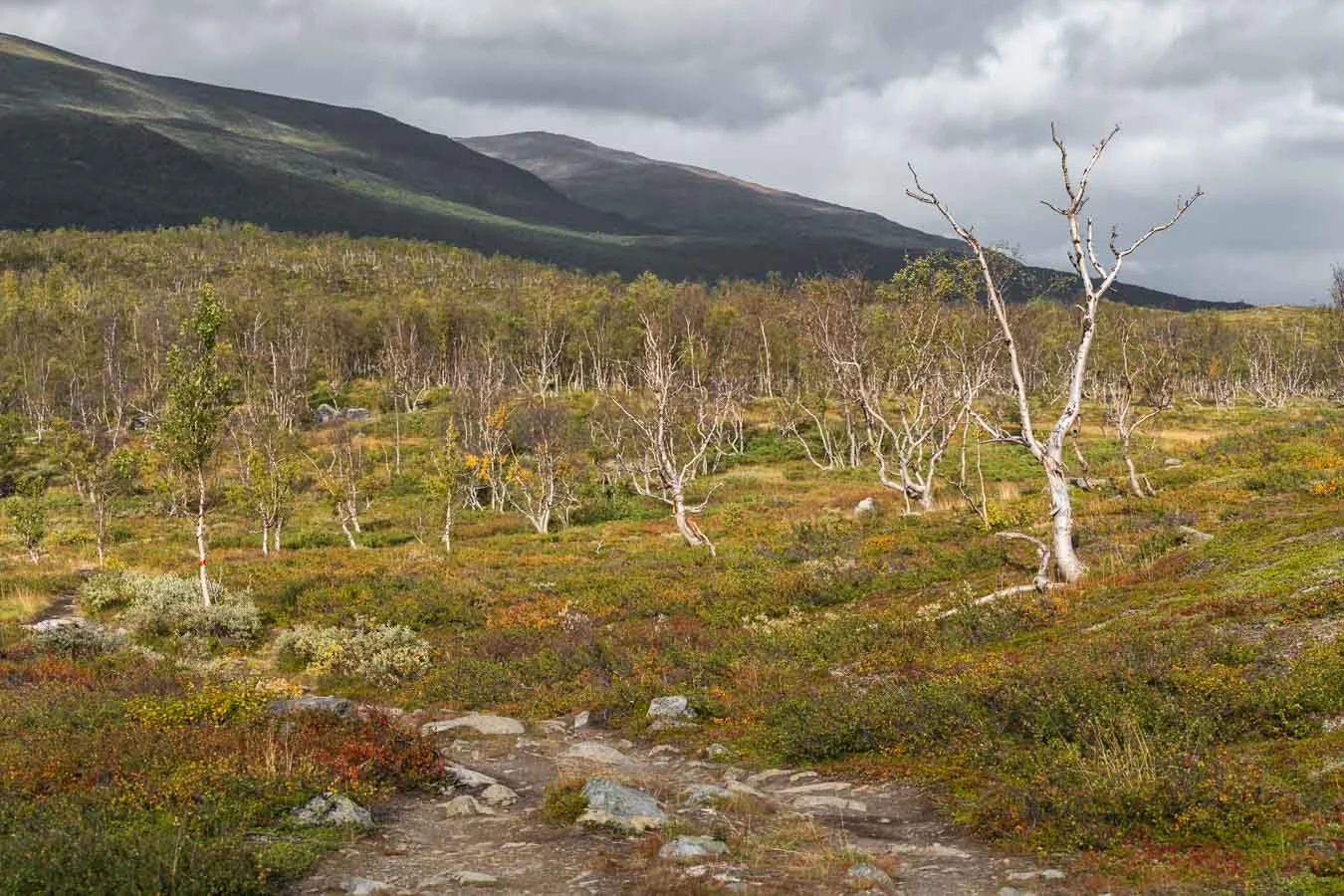
The scenery changes noticeably with elevation and whether you are above or below the tree line. At lower elevations you walk through lush mountain birch forests. Their dominance here is linked to the subalpine/subarctic climate, the park’s location near the climatic treeline, relatively poor soils, short growing seasons, and disturbances such as insect outbreaks and reindeer browsing – all conditions birch trees tolerate better than most conifers.
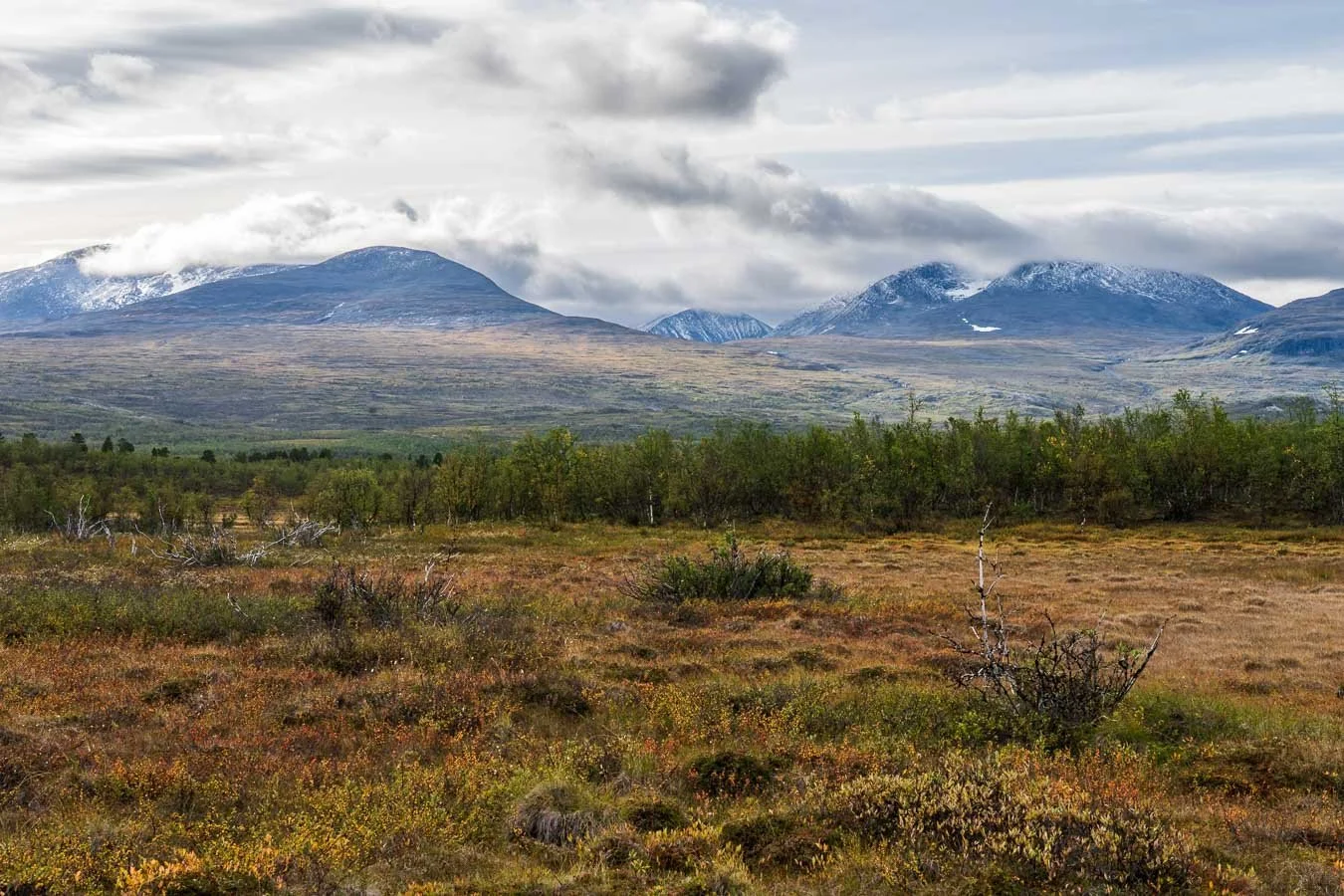
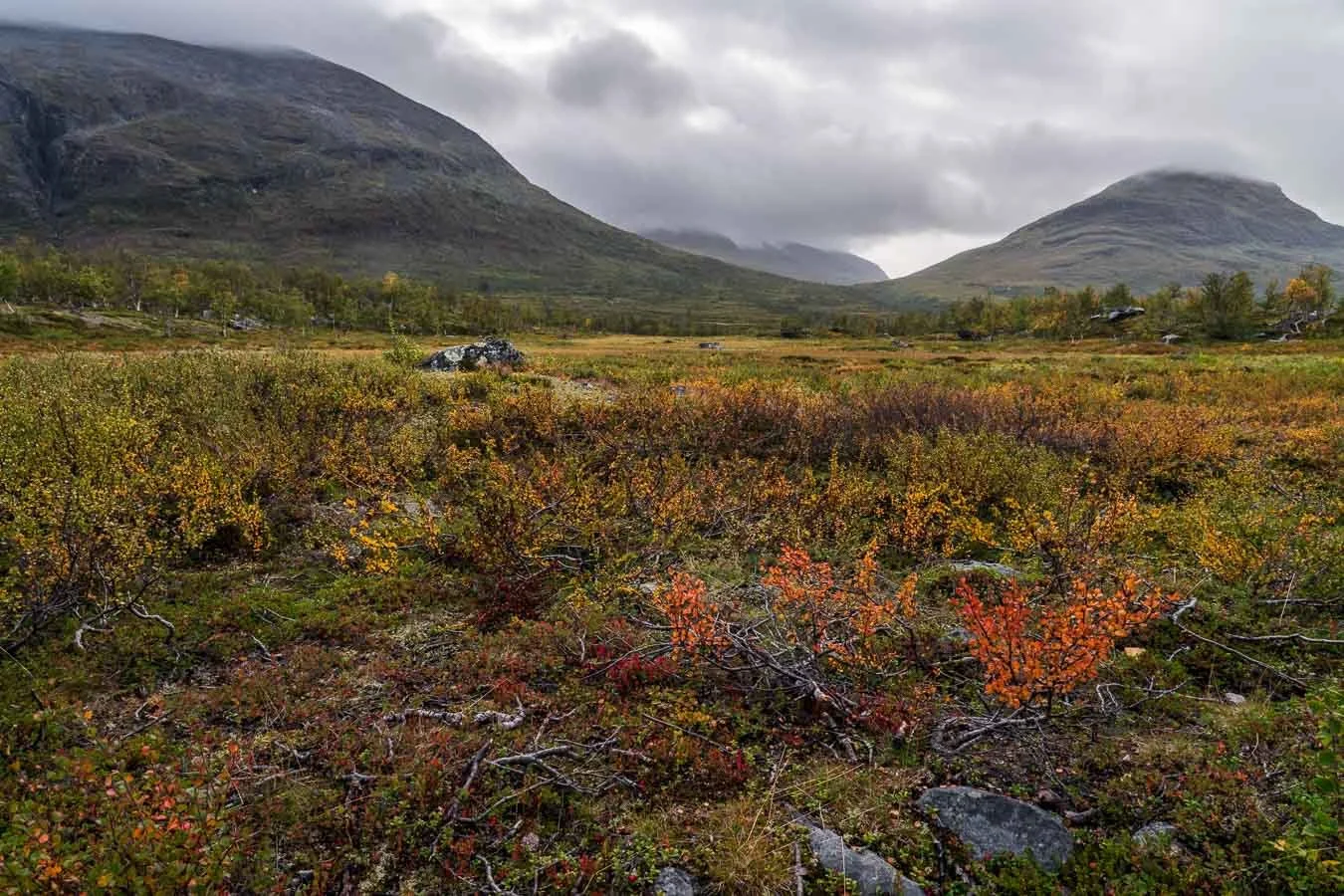
As you climb higher and cross the climatic treeline, the birches thin out and give way to dwarf shrubs, heather, and low bushes that turn intensely colourful towards autumn. The trail becomes more alpine, winding between mountain ranges, with lakes scattered in the valleys. You may also encounter reindeer belonging to local Sámi communities.
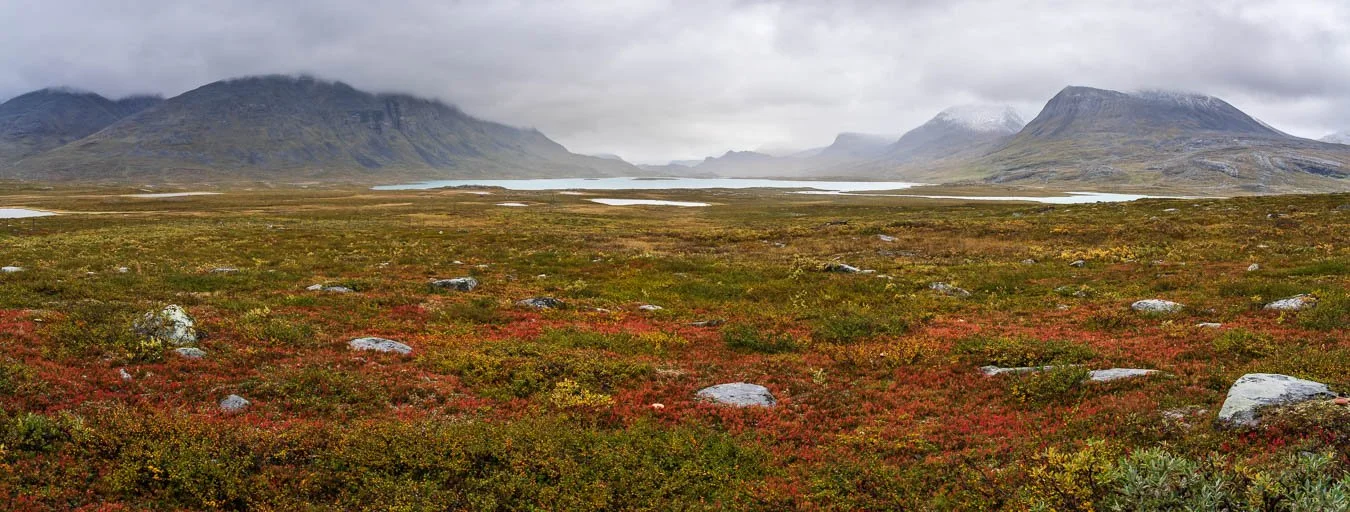
Scenery along the Kungsleden trail at higher elevations, featuring lakes between mountains and a variety of colorful shrubs and bushes, which are especially vivid during autumn.
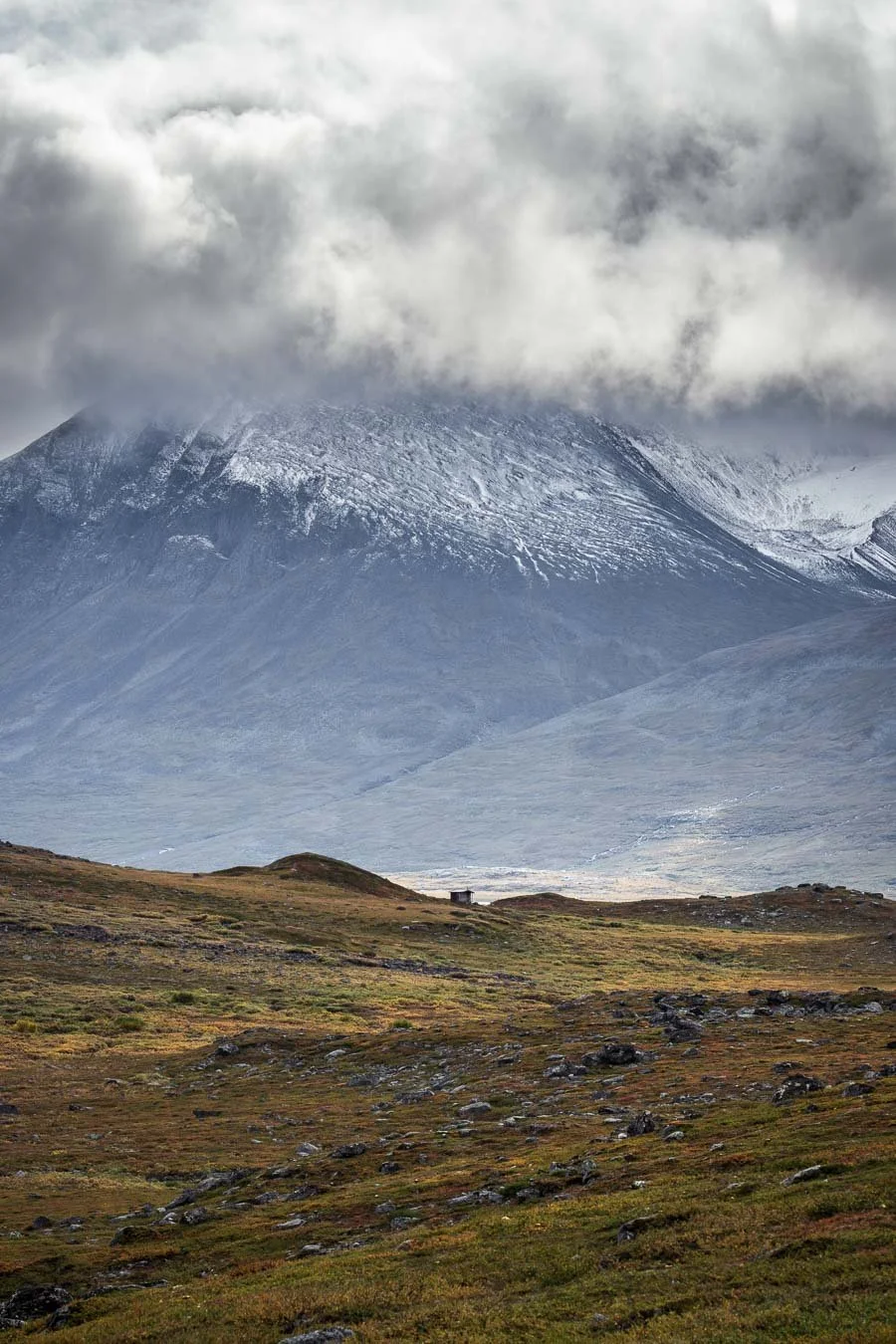
The Kungsleden is probably the main reason many hikers travel to Abisko (and to Kiruna further south), and the best time to hike it is in mid to late summer. However, Abisko is just as compelling in winter, albeit for very different reasons. The next part of this section walks through our experiences in Kiruna and Abisko during the colder months.
Abisko in Winter
Our second visit to Abisko took place in January, the middle of winter in Swedish Lapland. The main reason we chose this time of year was simple: Abisko is one of the prime locations on Earth to see the northern lights.
Abisko lies within the so-called auroral oval, a band around the geomagnetic poles where northern lights activity is particularly frequent. Combined with relatively low light pollution and a mountain-shielded location that often leads to clearer skies than the surrounding region, this gives Abisko very good odds of visible auroras on dark, cloudless nights; in particular during periods of elevated geomagnetic activity (reflected in a high KP-index).
When we arrived, my aurora forecast app immediately notified us of very high KP values over the next few hours. We dropped our bags at our accommodation and went straight down to the Abisko River Delta and the shores of Lake Torneträsk.
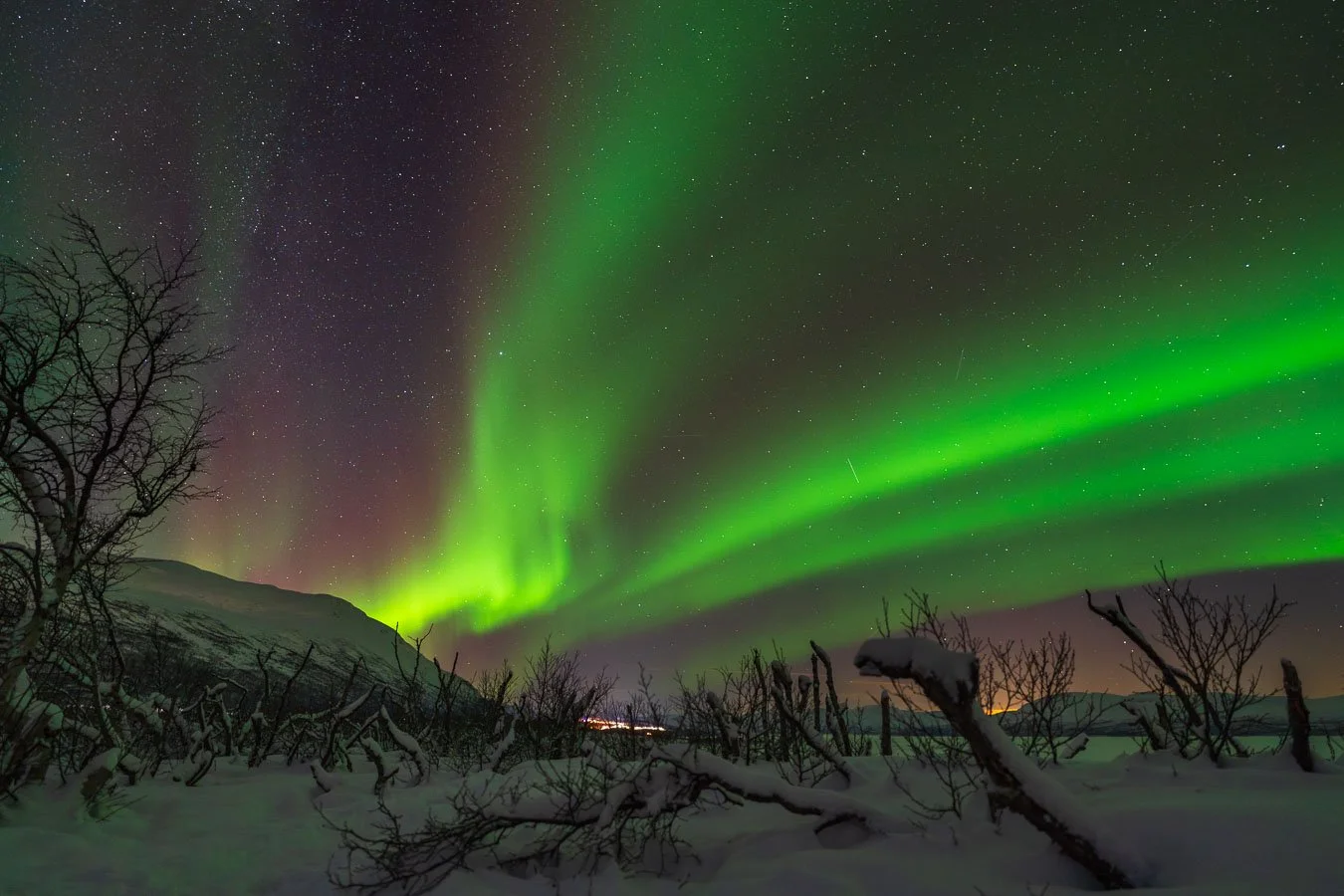
Vivid auroras dancing above Lake Torneträsk in Abisko National Park - a short video of this display is available here.
The northern lights stayed active for a long time, and during the whole session we encountered only one other small group near the shore. With temperatures around –20 °C and us standing still most of the time, we eventually cooled down to the point where both we and our gear started freezing up. After roughly an hour we packed up and headed back to the STF Abisko Turiststation to thaw out.
This accommodation is an excellent base if you want flexibility to explore the surrounding area. The shores of Lake Torneträsk are about a 20-minute walk away. The trails are not technically difficult, but they can be icy, so micro-crampons or snowshoes are useful. As an alternative or complement to going out on your own, you can book a guided northern lights tour by car or minibus, or visit the Aurora Sky Station. The Sky Station is reached by chairlift and offers unobstructed panoramic views from the mountain, which can significantly increase your chances of a good aurora display when conditions are right.
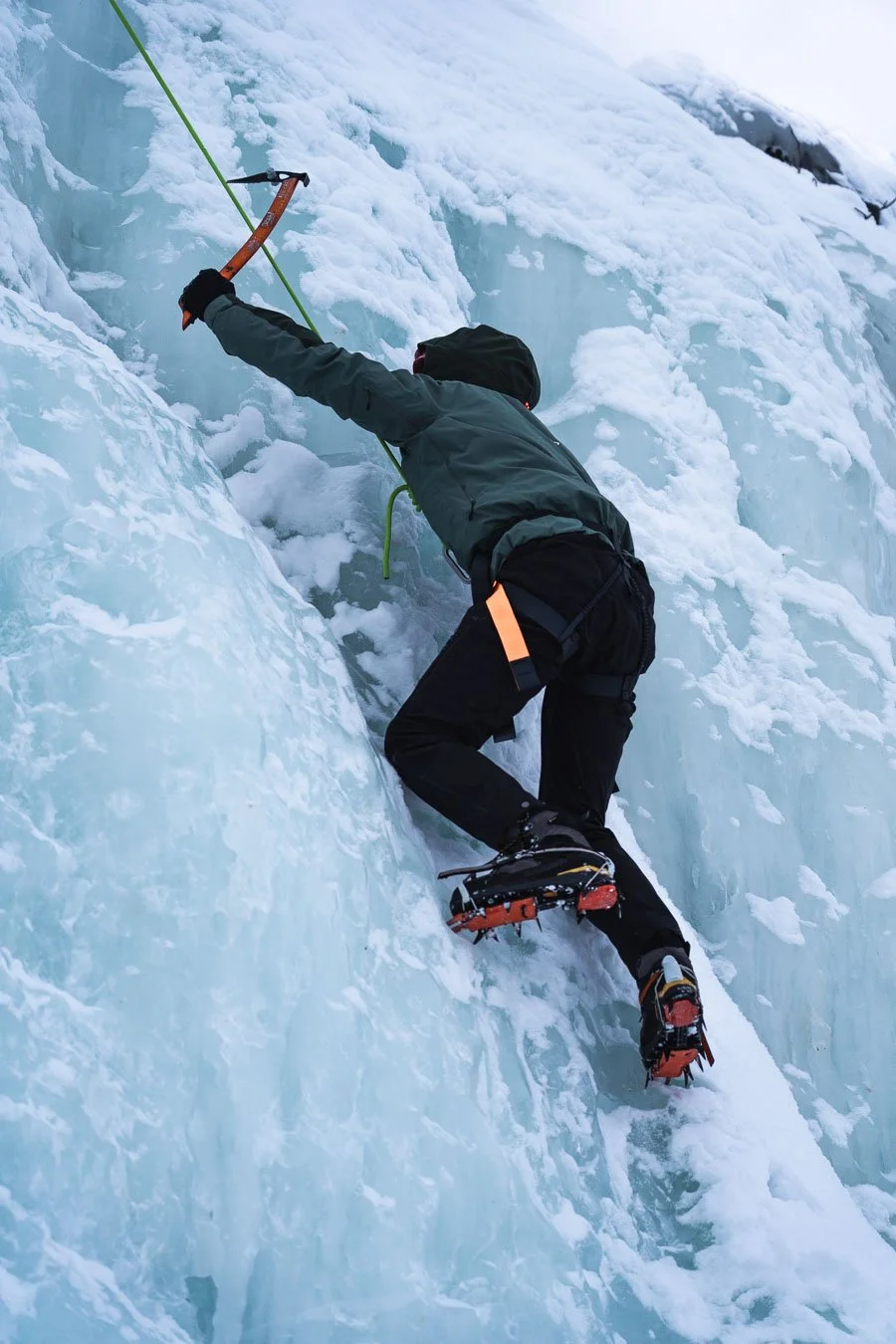
Aurora hunting is far from the only winter activity available, though. The next morning we joined an introductory ice-climbing session. We were picked up at the STF Abisko Turiststation and driven to a frozen waterfall just outside Abisko. There we geared up, got a crash course in basic technique, and then each had several turns climbing the waterfall ourselves. If you enjoy a small adventure or already like rock climbing, this is a great way to spend a winter morning. Several operators offer similar tours; most last around three hours and cost in the range of 100 € (often including a hot drink).
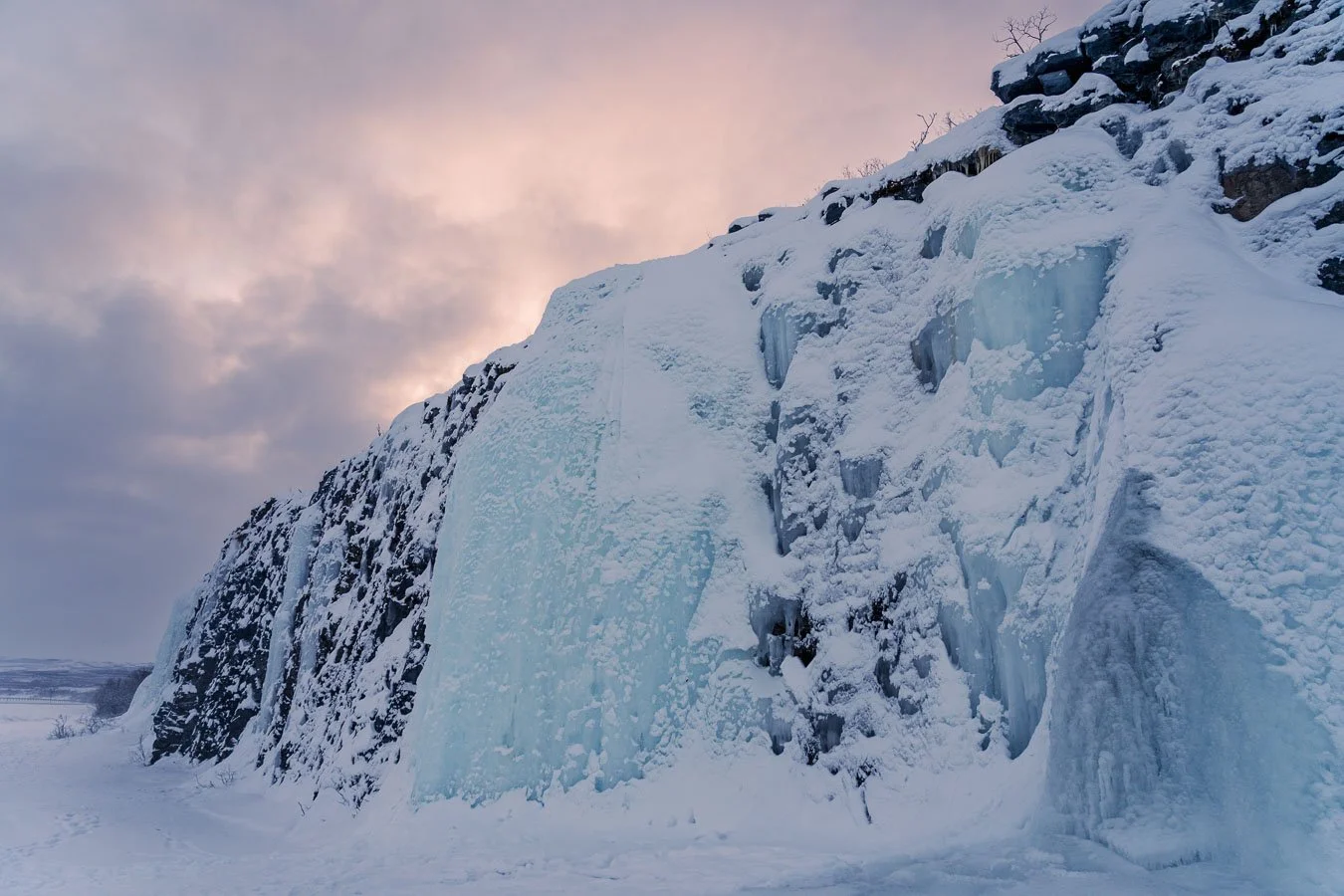
Frozen waterfall commonly used for guided ice climbing sessions in Abisko during winter.
That evening, the forecast again promised high KP values, but this time low clouds rolled in and blocked any northern lights. We used the ‘failure’ as a chance to get an early night before a sunrise hike in Abisko National Park. In January, you don’t have to get up painfully early to catch sunrise at this latitude, which makes a relaxed breakfast followed by a morning hike quite feasible.
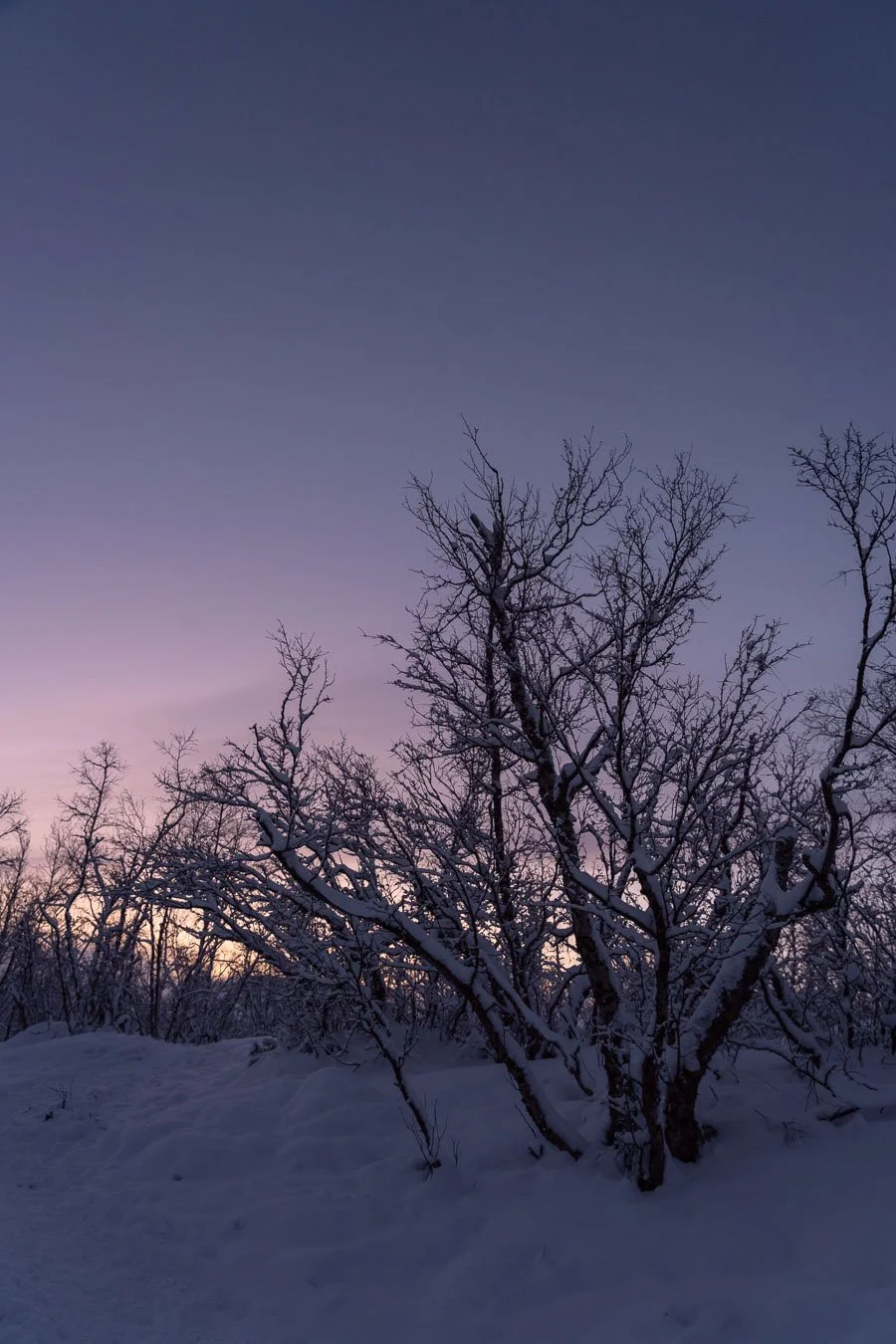
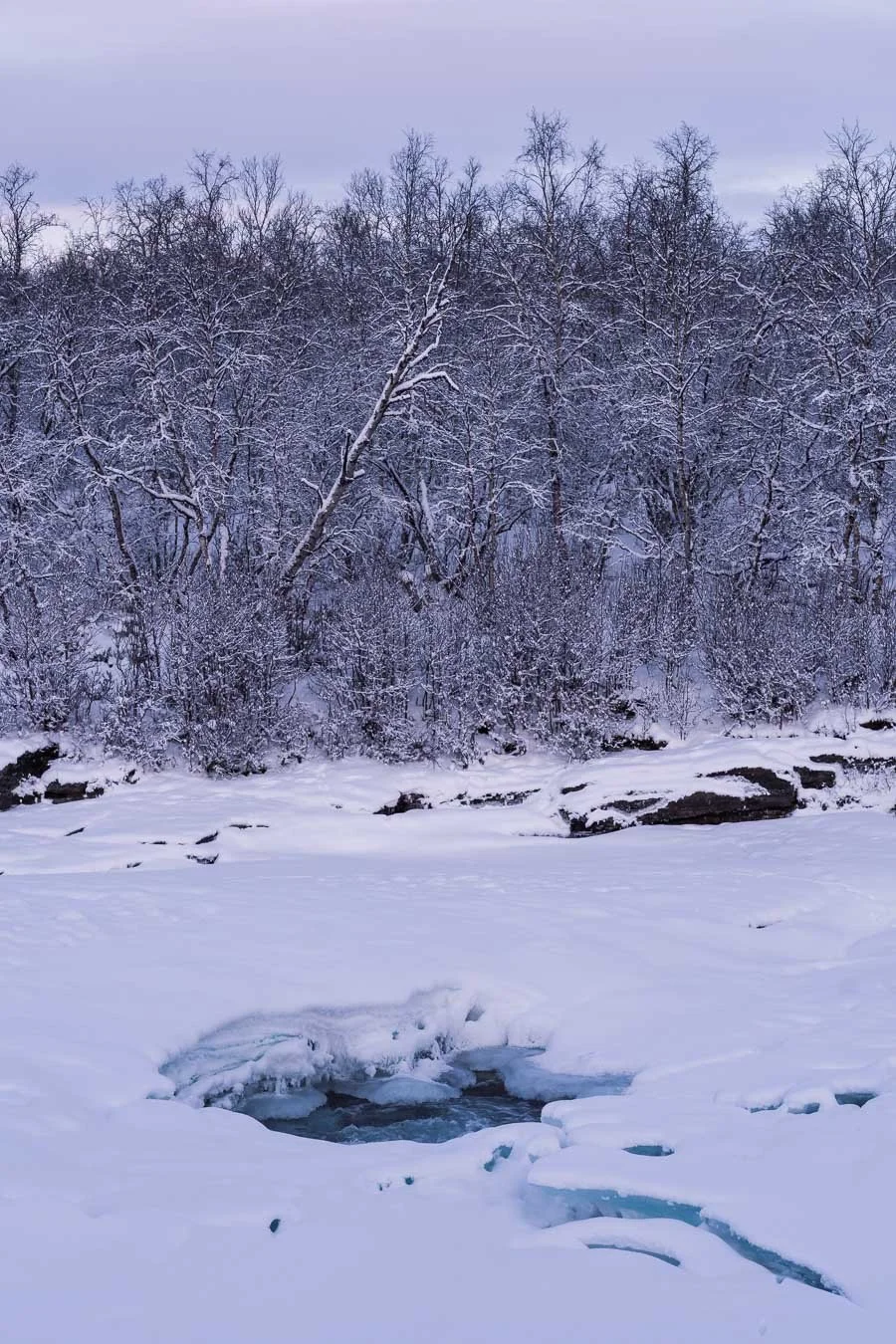
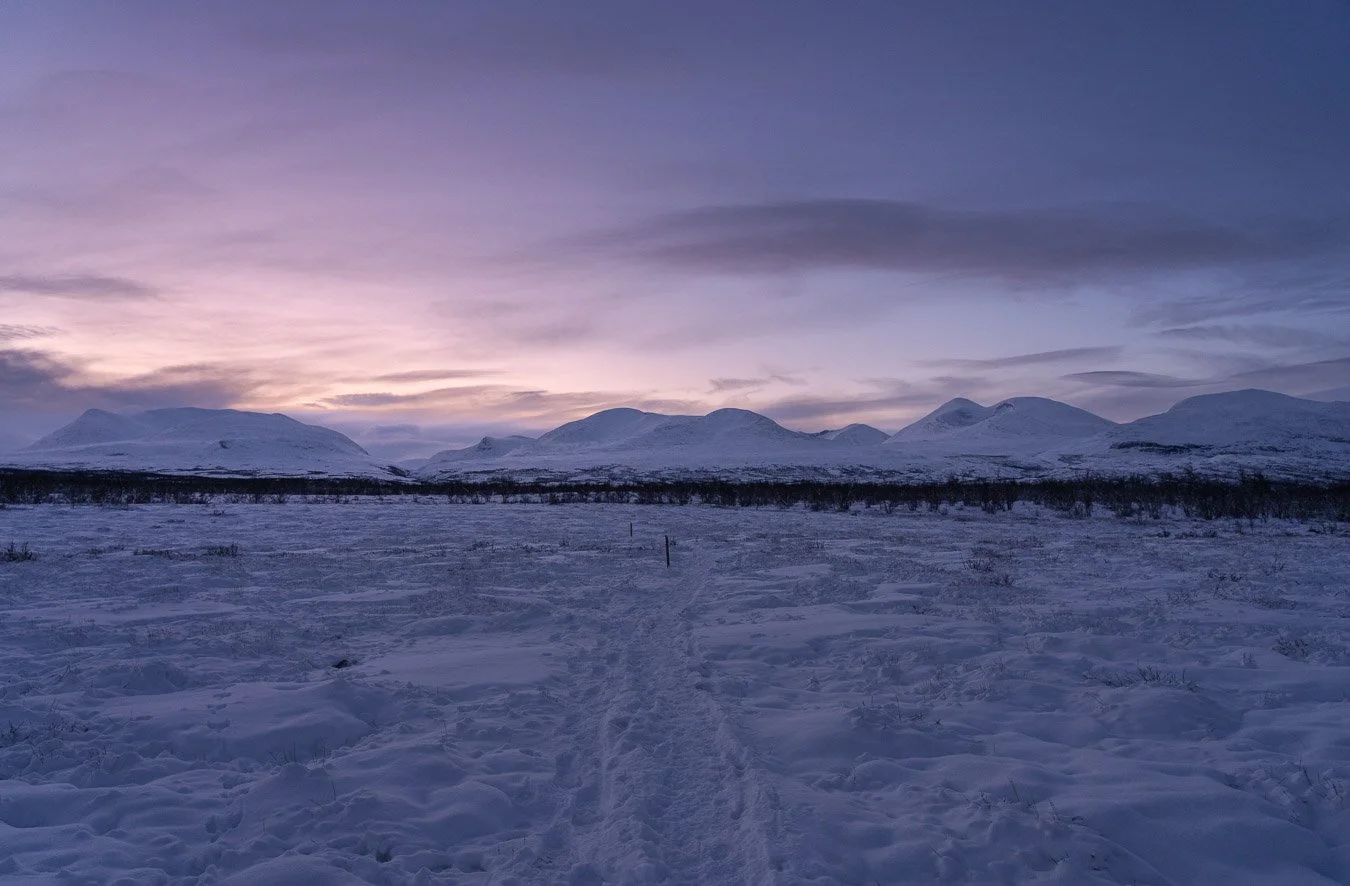
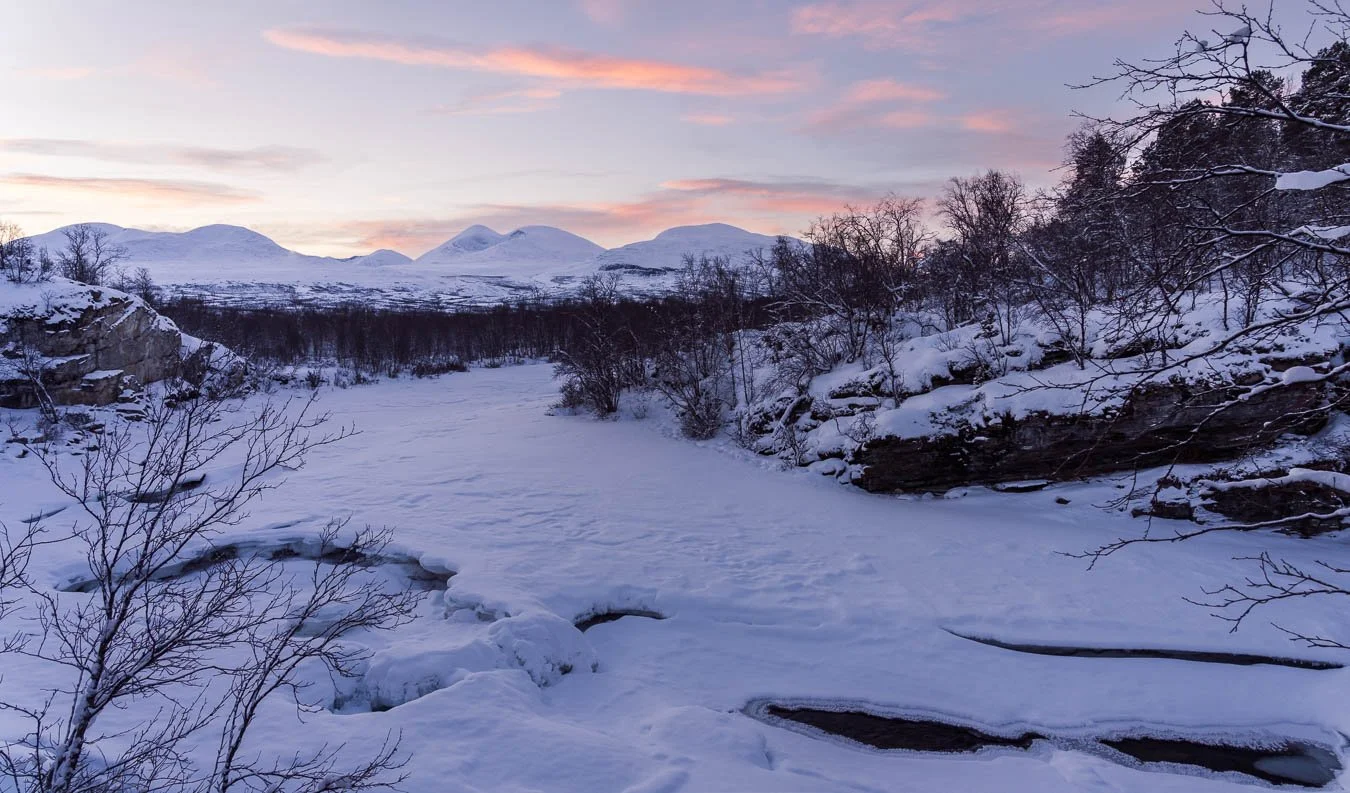
After layering up, we left around 9:00 to hike the Njakajaure nature trail and visit the Marmorbrottet quarry. This circular trail starts at the STF, is about 4.8 km long with roughly 114 m of elevation gain, and offers several good viewpoints. Heading out during blue hour already gave us beautiful soft light, with the sun just hovering below the horizon.
As we continued, the sun finally cleared the horizon and the light turned even more impressive. The low angle accentuated every small irregularity in the snow surface, creating dramatic depth and textbook ‘winter wonderland’ scenes.
For this hike you can either rent snowshoes to make walking through deep snow easier, or simply bring micro-crampons if conditions are icier than snowy. Guided snowshoe tours through the park are also available if you prefer a bit more structure or don’t want to worry about route-finding.
Another classic winter activity in the region is dog sledding. Historically, dog sleds were a crucial means of transport in deep snow, used to move people, goods, and even mail over long distances. Today, they still play a role in some remote communities but are primarily a tourism activity. Several operators offer tours of different lengths both in Abisko and around Kiruna.
We opted to do our tour in Kiruna, which can be more convenient if you’re already flying in or out via Kiruna airport. It’s also possible to arrange transfer from Abisko to Kiruna specifically for dog sledding, but this is typically more expensive.
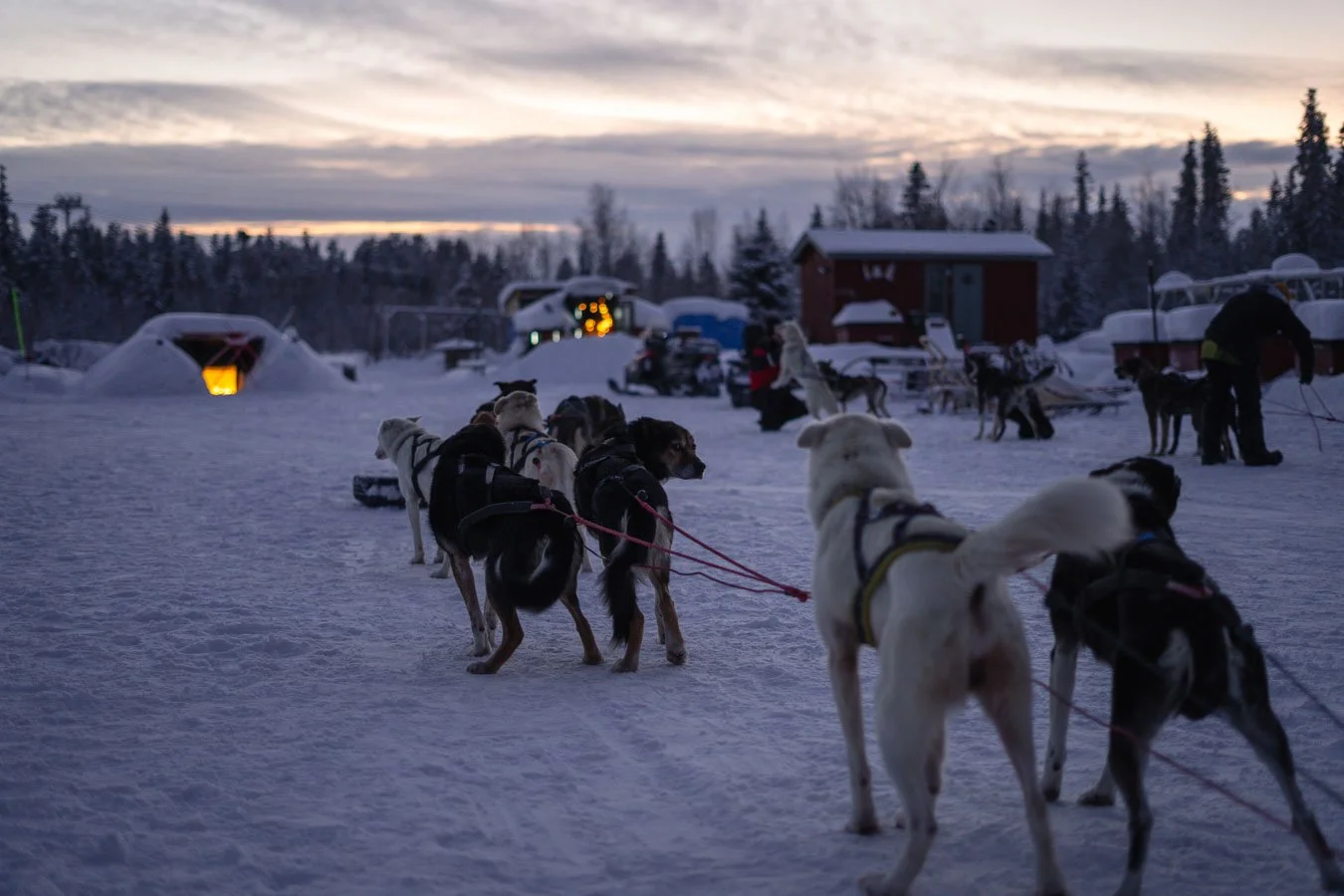
Team of sled dogs getting ready for a run.
We chose Snowdog Arctic Adventures, which at the time offered the best price–duration ratio for our dates. Since we booked the afternoon tour, they picked us up from our hotel around 14:00 and drove us to the sledding base together with the other participants. Once there, we got to meet the dogs before changing into the provided gear, that is, snowsuits, wool layers, hats, and additional insulation. You may still get cold (especially since the sleds can pick up quite some speed), but it helps a lot.
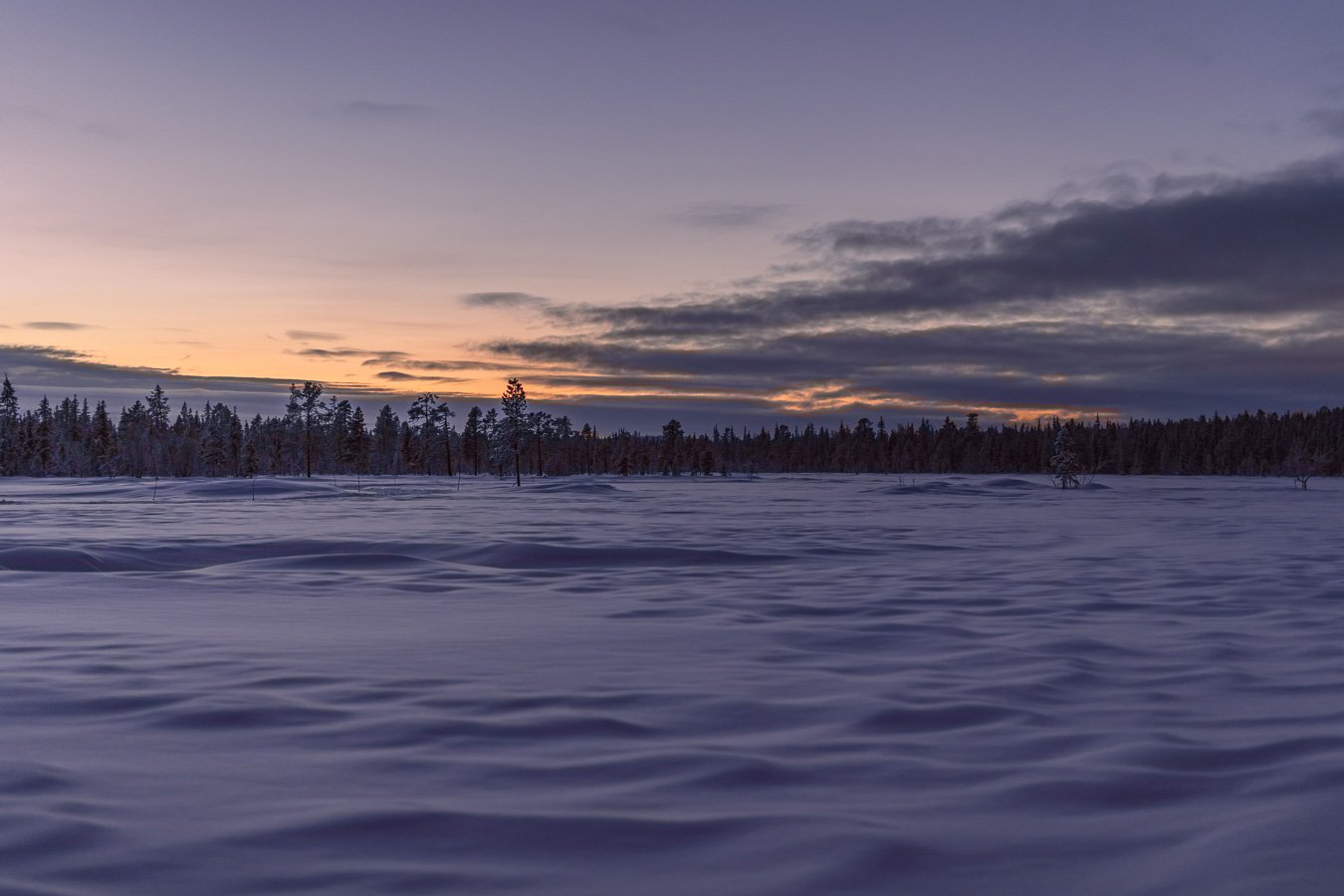
Winter landscape at sunset, typical of the scenery you may encounter during a dog sledding adventure in Swedish Lapland.
Once everyone was dressed, we were paired up and assigned to a sled and team, each with a guide handling the steering and safety. We set off and barely made it through the first turn before two of the lead dogs decided they didn’t want to work together, adding a brief bit of chaos to the experience. After that it was smooth running. The guides led us across a frozen lake for roughly an hour with a short break for the dogs midway. As the sun dropped, the cold crept back into our toes, fingers, and cheeks, made worse by occasionally strong headwinds. In hindsight, the morning tour might have been the better choice for slightly warmer temperatures. Either way, it was a memorable and not particularly demanding way to experience the winter landscape.
Kiruna
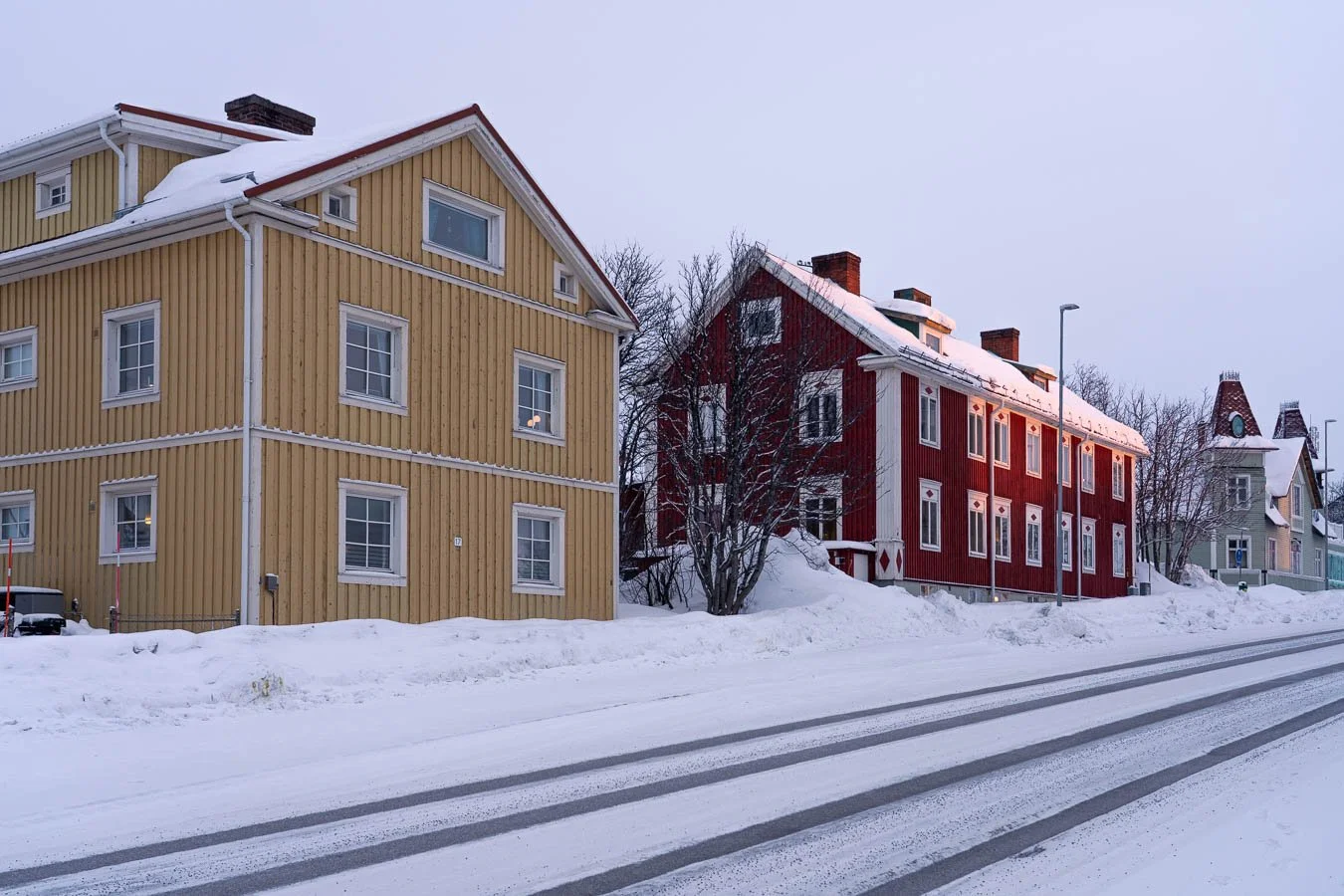
Besides serving as a hub for activities like dog sledding, Kiruna itself is worth some exploration. Despite its small size, it has a few worthwhile sights, most notably Kiruna Church with its separate bell tower. The church is among Sweden’s largest wooden buildings and is known for its distinctive National Romantic design with Gothic Revival influences.
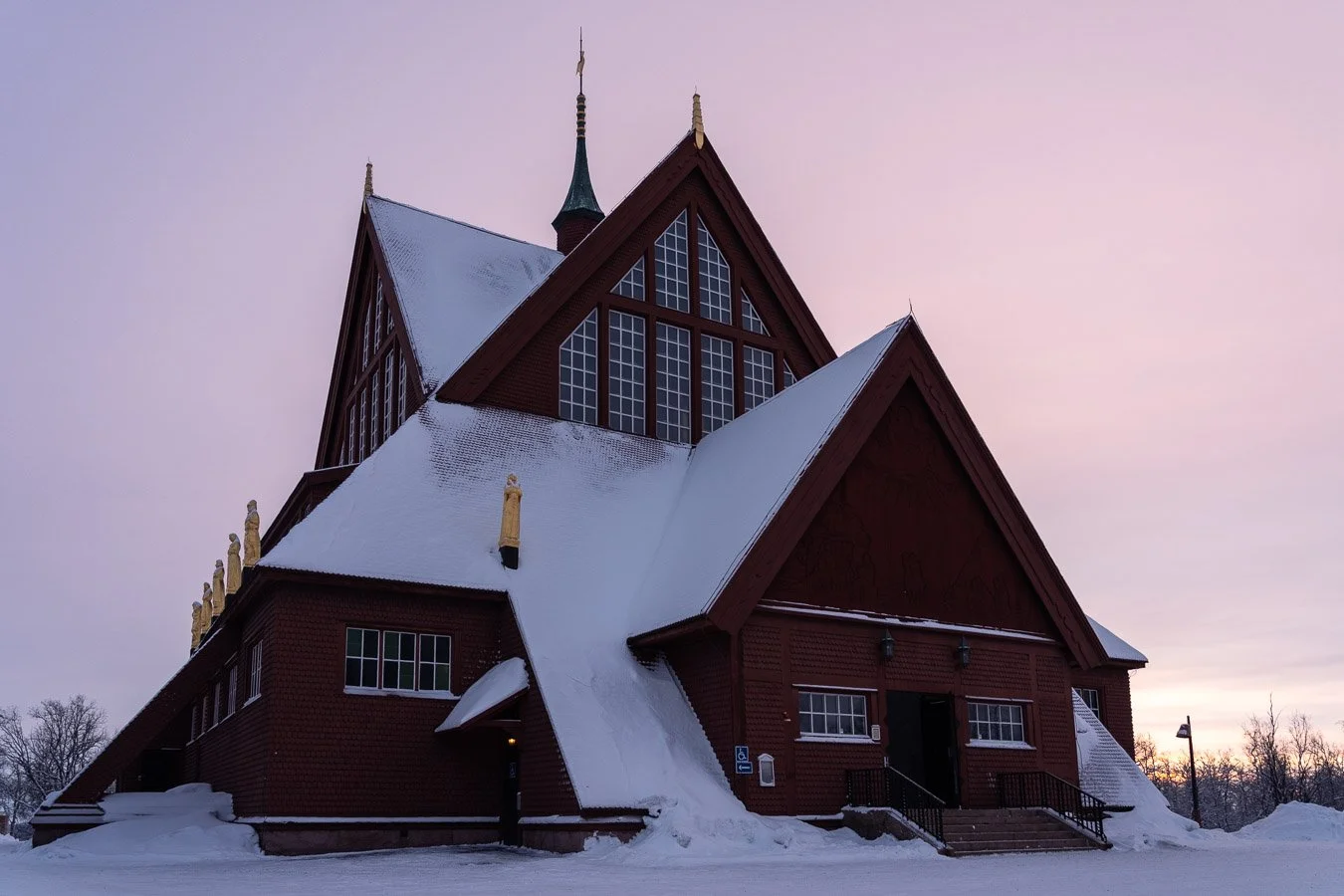
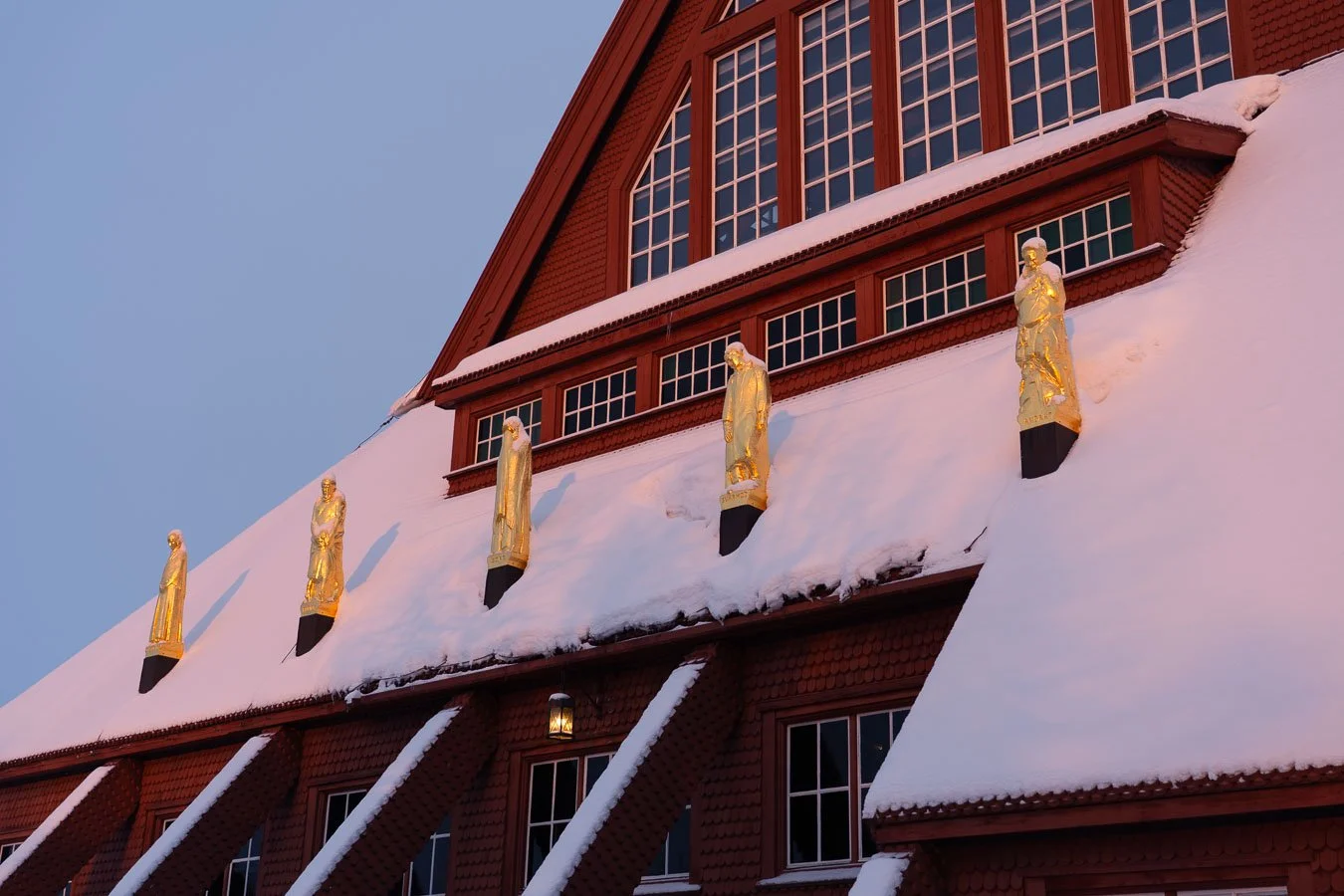
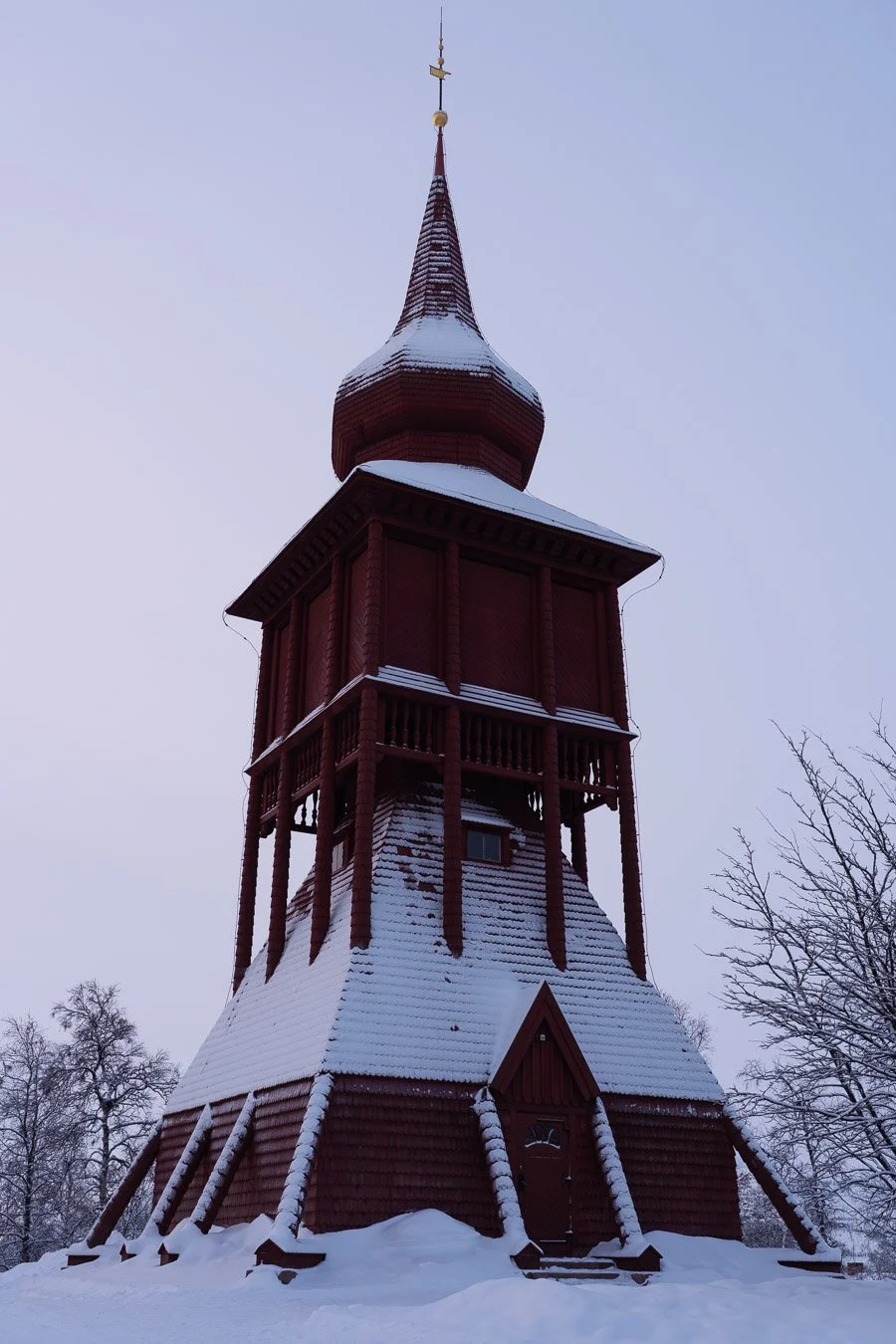
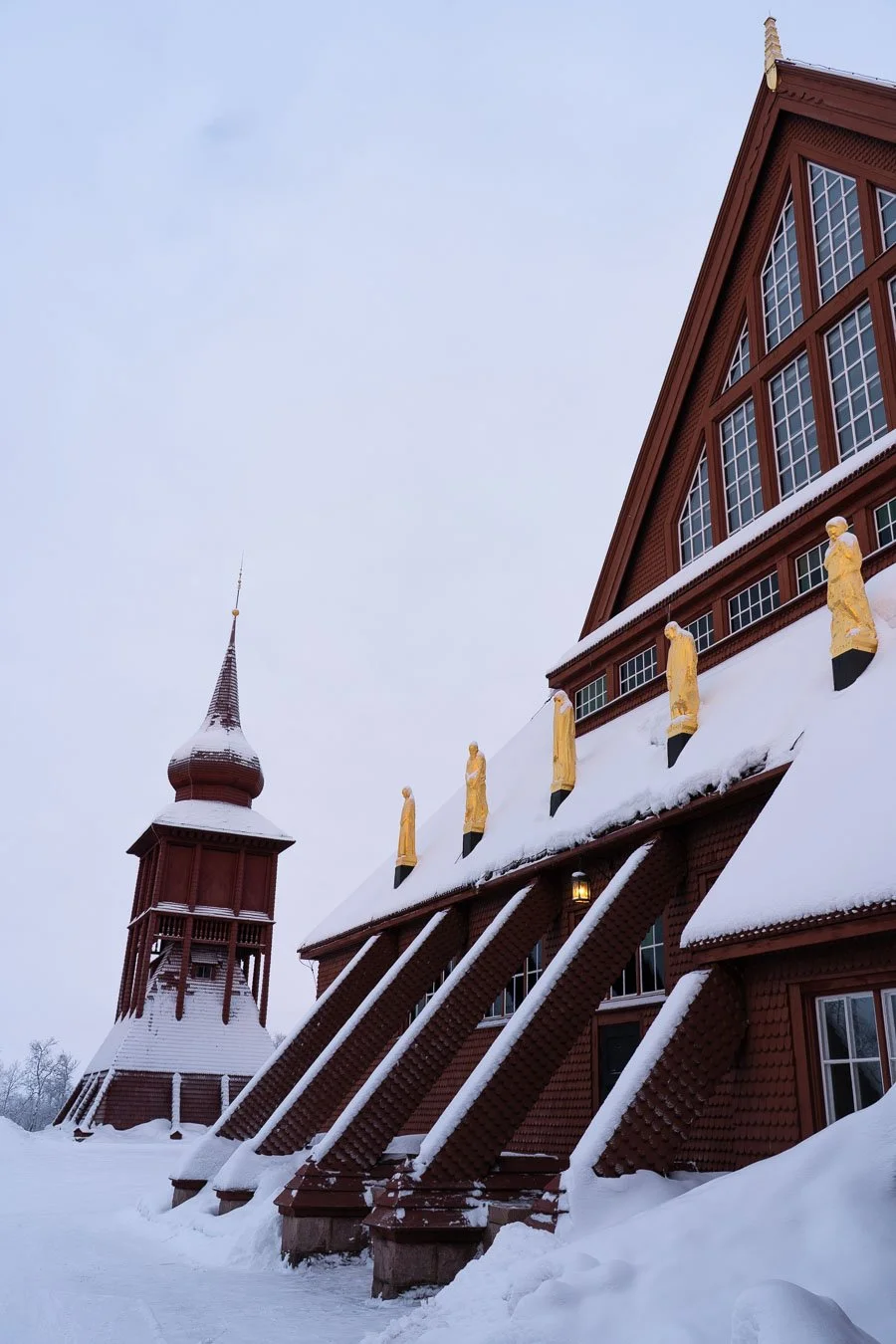
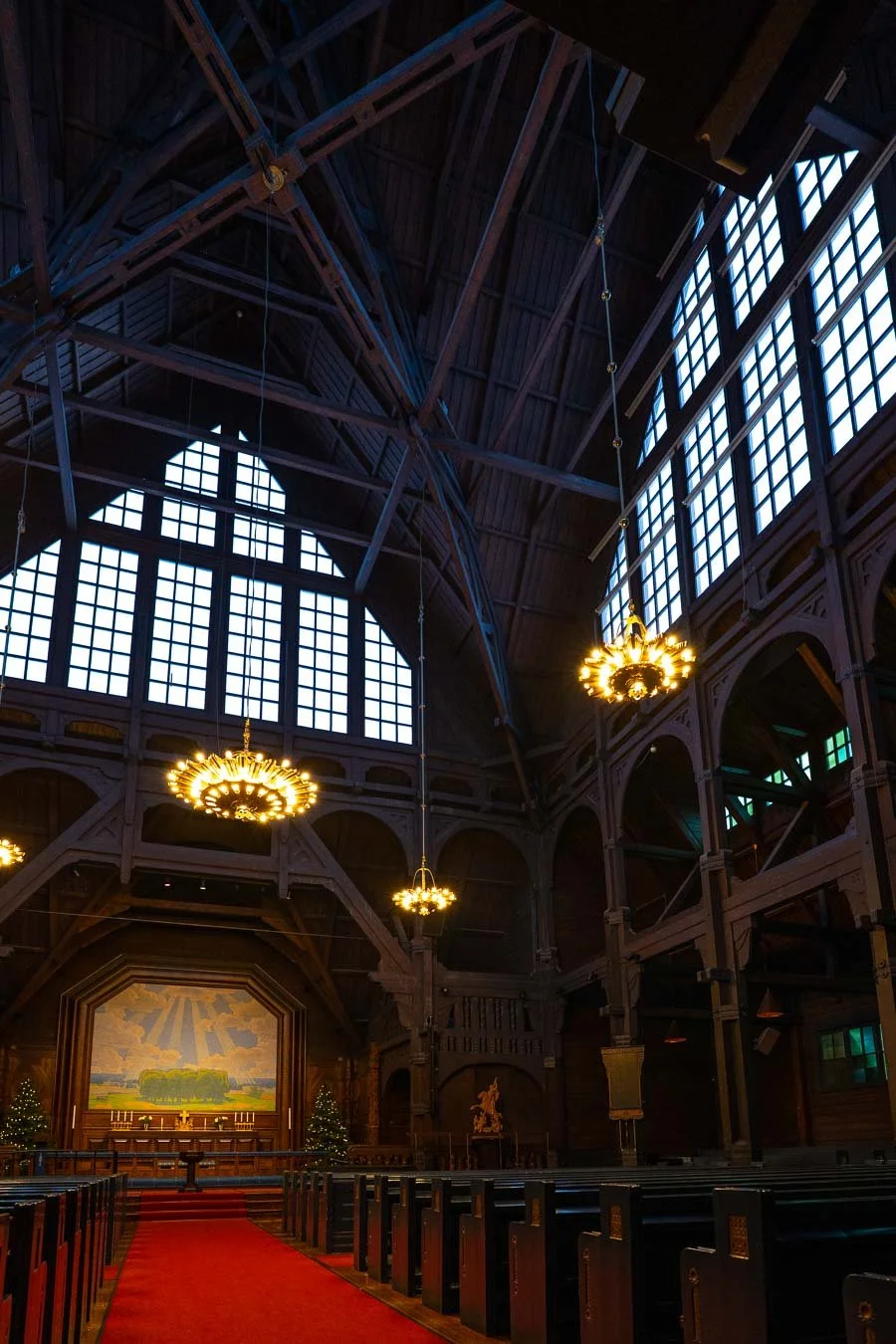
Kiruna is also famous because the town is quite literally moving. Ongoing iron ore mining has caused ground subsidence, making it necessary to shift the town center about 3 km west to safer ground to accommodate continued mining. As part of this move, the iconic church was relocated in summer 2025. The entire building was transported on a massive frame with wheels.
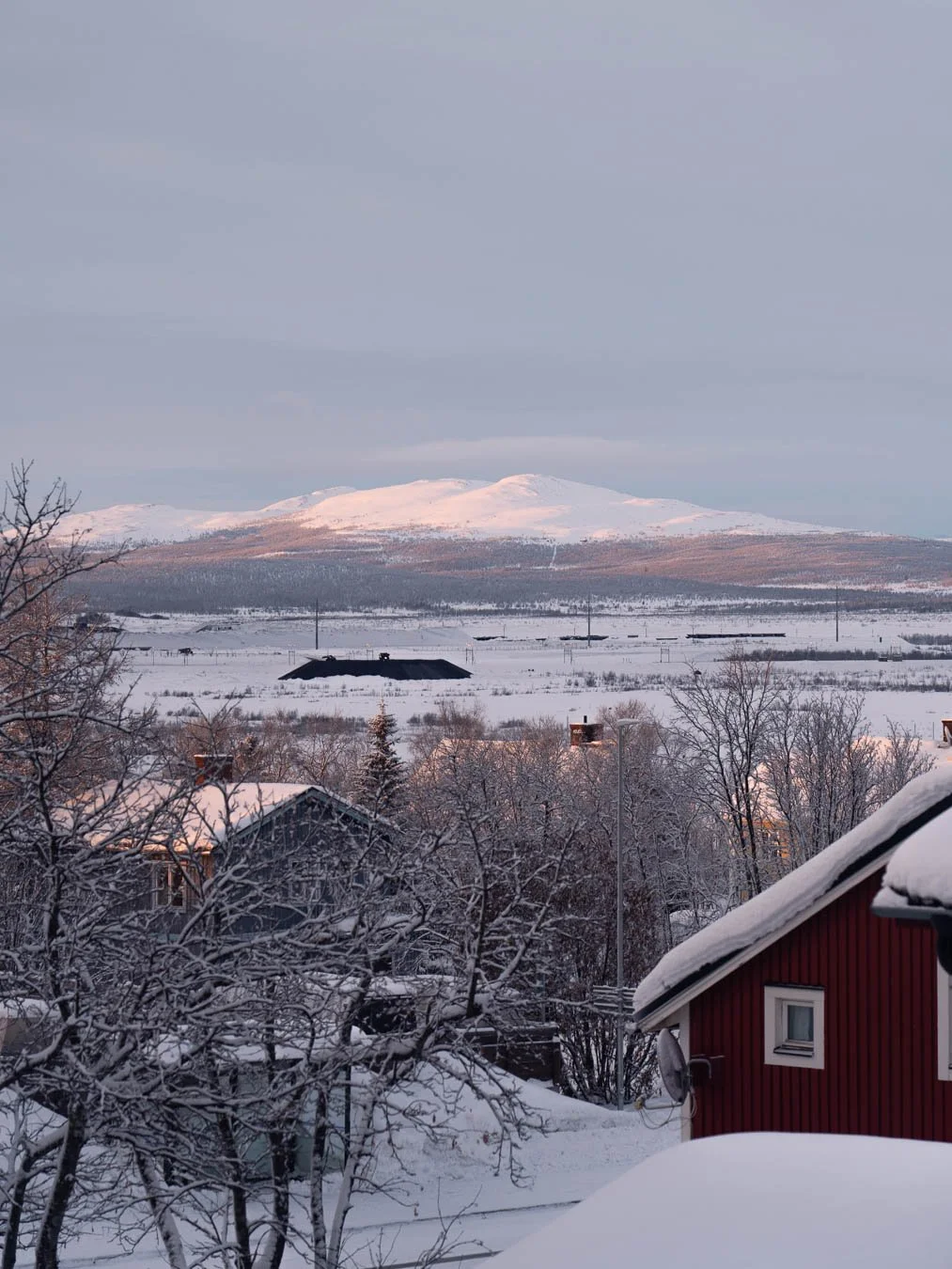
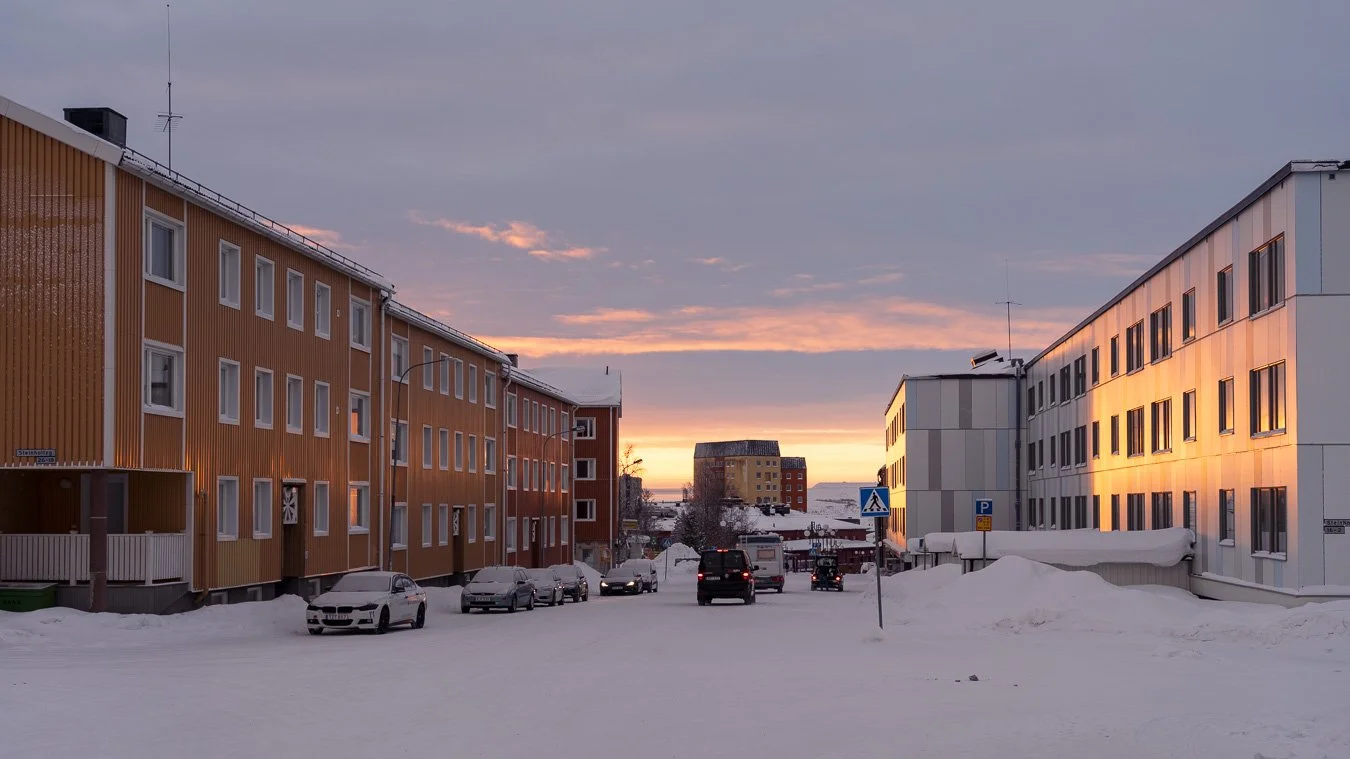
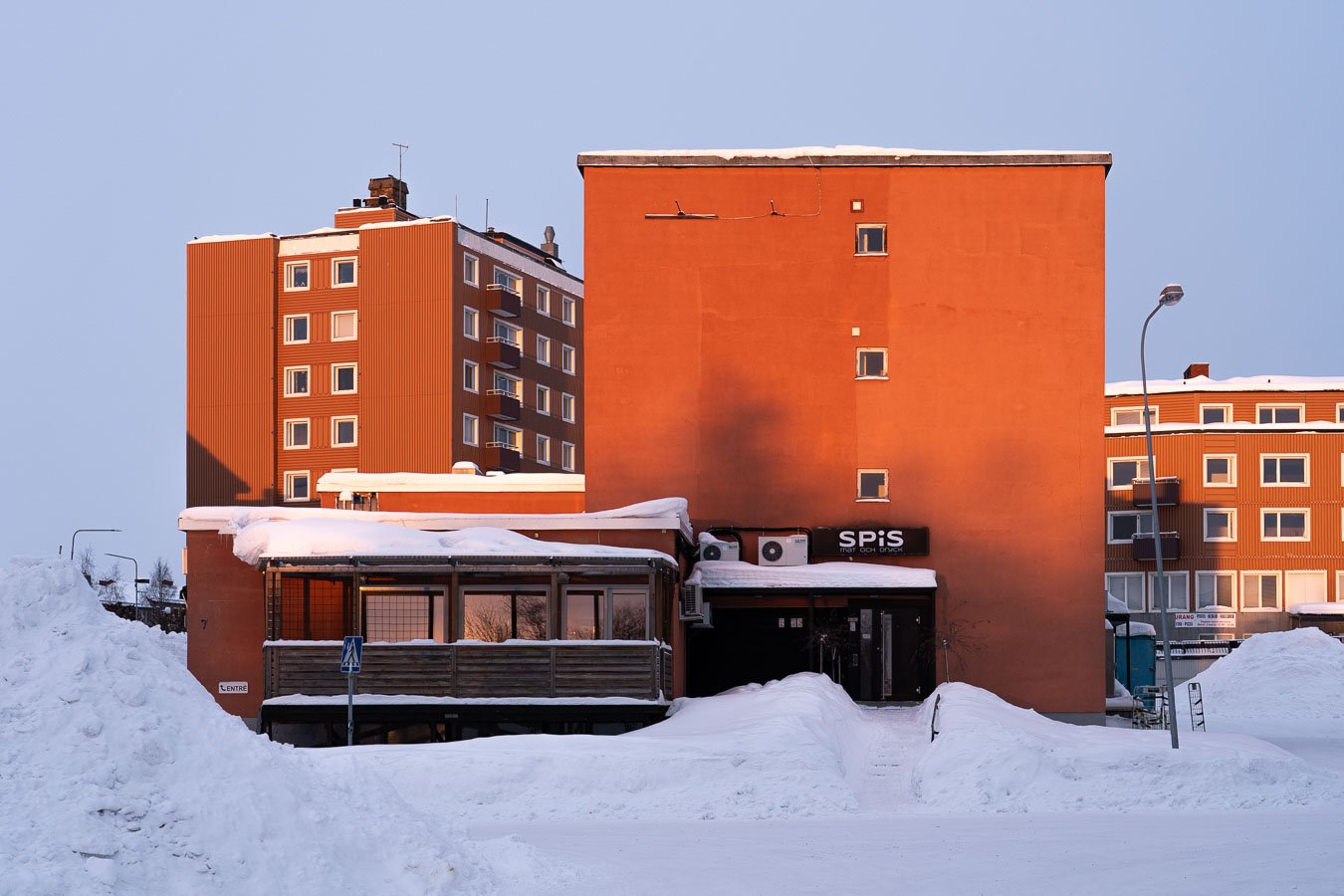
The new town layout, with more open spaces, straighter roads, and modern, larger buildings in a slightly lower-lying area, has reportedly changed the local microclimate, making winters feel a bit colder and windier than before. Historically, Kiruna was seen as something of a model city for life and urban planning in the Arctic, but the recent relocation has given it a noticeably more modern and less traditional appearance.
The mine itself – the LKAB iron ore mine, one of the largest of its kind in the world and in operation since 1899 – is also a popular attraction. Guided tours run year-round and offer a glimpse into large-scale Arctic mining.
While we only stopped in Kiruna for dog sledding and a short walk around town, there are other activities you might consider. One of the biggest draws is the Icehotel in Jukkasjärvi, east of Kiruna. Each winter, a new hotel is built from ice blocks cut from the frozen Torne River, so the design changes every year. Staying there or just visiting the ice rooms and bar can be a memorable experience.
Similar to Abisko, Kiruna and Jukkasjärvi offer guided winter tours such as snowmobiling, snowshoeing, and northern lights excursions into darker areas outside the town. However, if your goal is to find the most reliable aurora viewing conditions, Abisko usually has the edge.
In the next section, you’ll find more practical tips and considerations that can help you decide whether summer or winter in Abisko (or both) is the better match for you.
Planning & Preparation Advice
Getting to Abisko
How you get to Abisko depends largely on where you start your journey and how much time you have. The most relaxed option, especially if you’re already in Sweden, is the train. Despite Abisko’s tiny size, there is a direct overnight train from Stockholm (with stops in Uppsala and further north) that takes you all the way there. As this train crosses almost the entire country from south to north, the journey takes around 17 hours.
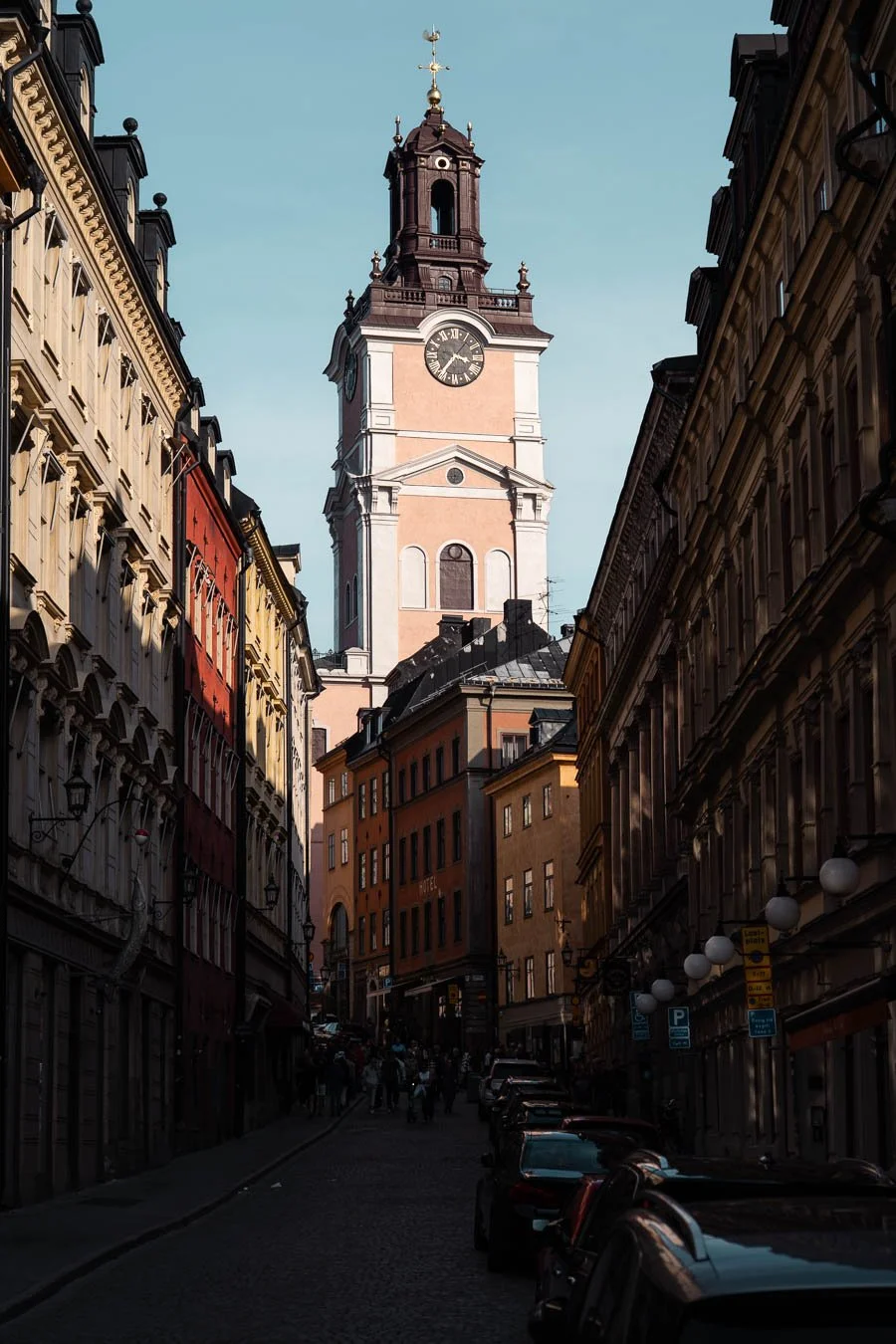
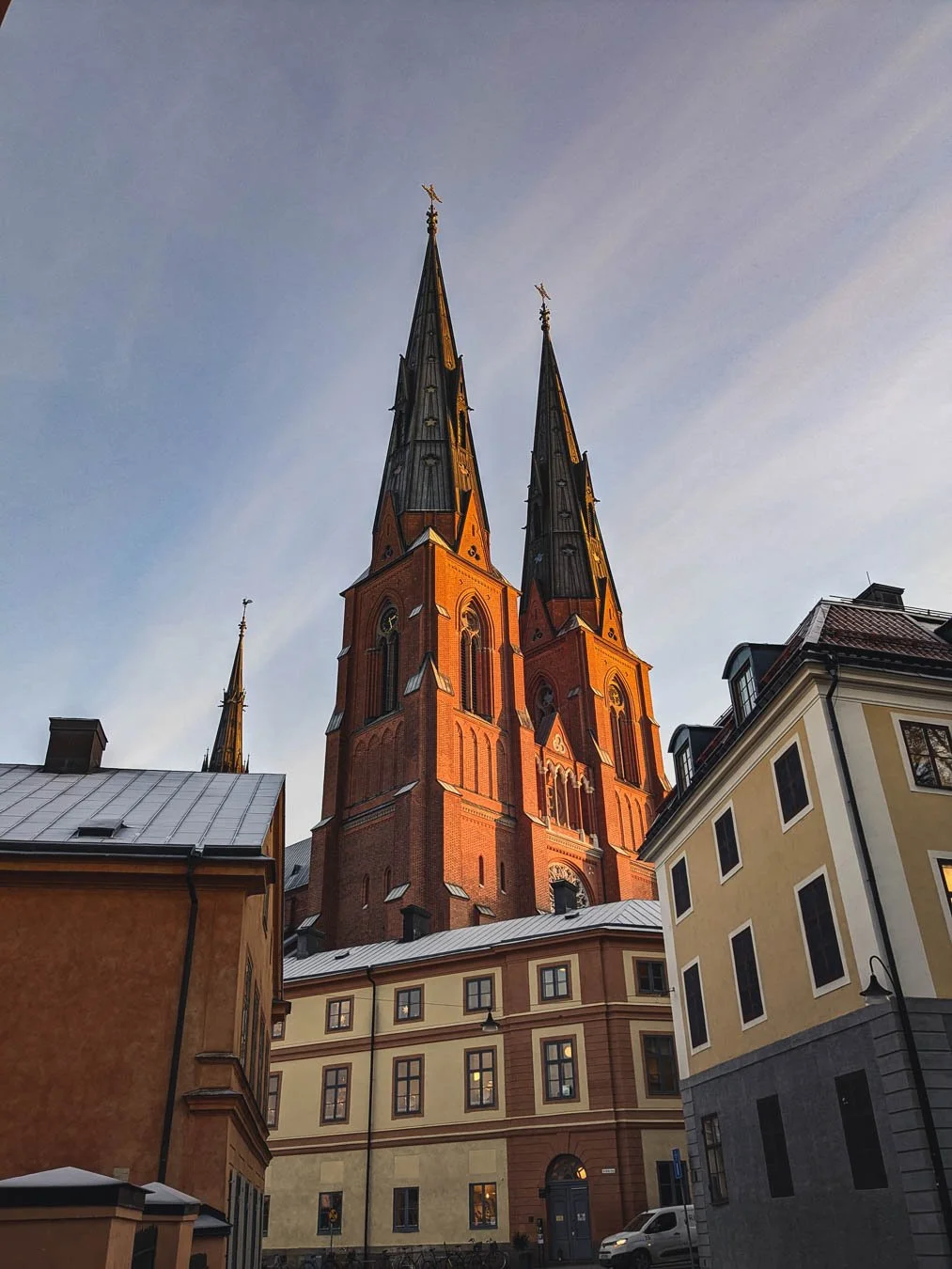
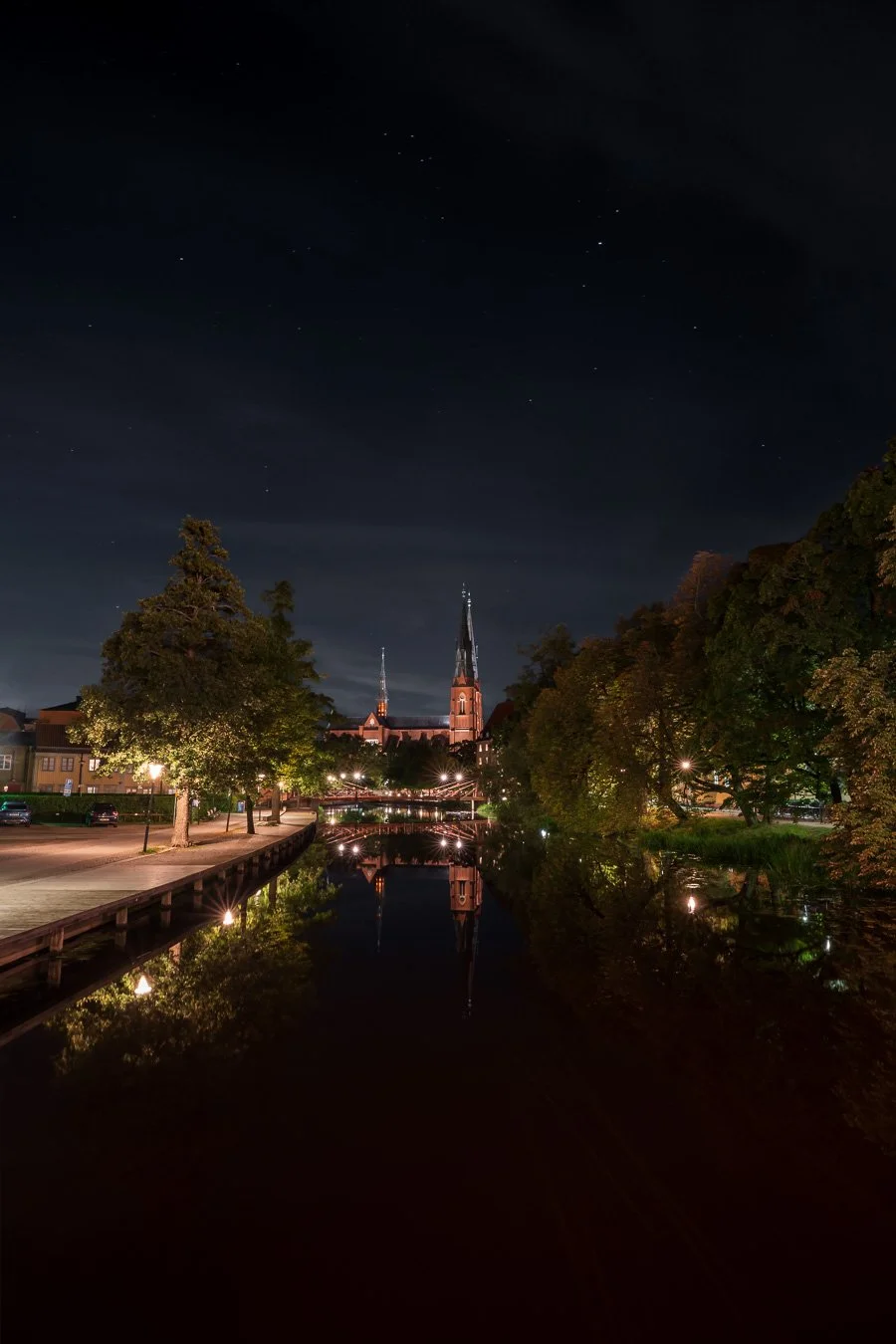
That sounds long, but it’s more comfortable than it appears on paper. Since it’s an overnight train, that usually leaves in the early evening, it will arrive in the late morning the next day. You can choose between several classes, ranging from regular seats and 6-berth couchettes to private sleeper compartments. Taking the train makes the most sense if you also want to spend time in places like Stockholm, Uppsala, or other stops along the route before or after your Abisko trip.
If you only plan to visit Abisko and don’t want to spend extra time in Sweden, flying is faster. From Stockholm Arlanda you can take a domestic flight to Kiruna. From there, you’ll need to arrange onward travel to Abisko. There are only a limited number of train connections between Kiruna and Abisko and no frequent commuter-style service, so it’s important to book tickets in advance, as they can sell out. Alternatively, you can look into bus connections or shuttle services. Also, sometimes transfers are included when you book tours or activities.
We tried both options and would personally recommend the train if you have the time. It’s not a high-speed connection, but that’s exactly the point! You roll through forests, lakes, and gradually more rugged landscapes and see much more of the country than you ever would from a plane window.
Where to Stay
If you’re heading to Abisko to hike the Kungsleden, you can quite literally start walking as soon as you arrive. The overnight train usually pulls in around late morning, which gives you plenty of time to complete the first leg from Abisko to Abiskojaure or, if you prefer a shorter start, to the tent area near the suspension bridge over the Nissunjohka River. Both are reachable even if you stop for a coffee, snacks, or last-minute essentials (map, layers, equipment, food etc.) at STF Abisko Turiststation. Note that wild camping is not allowed inside Abisko National Park, so your first night has to be in one of the designated sites before you leave the park.
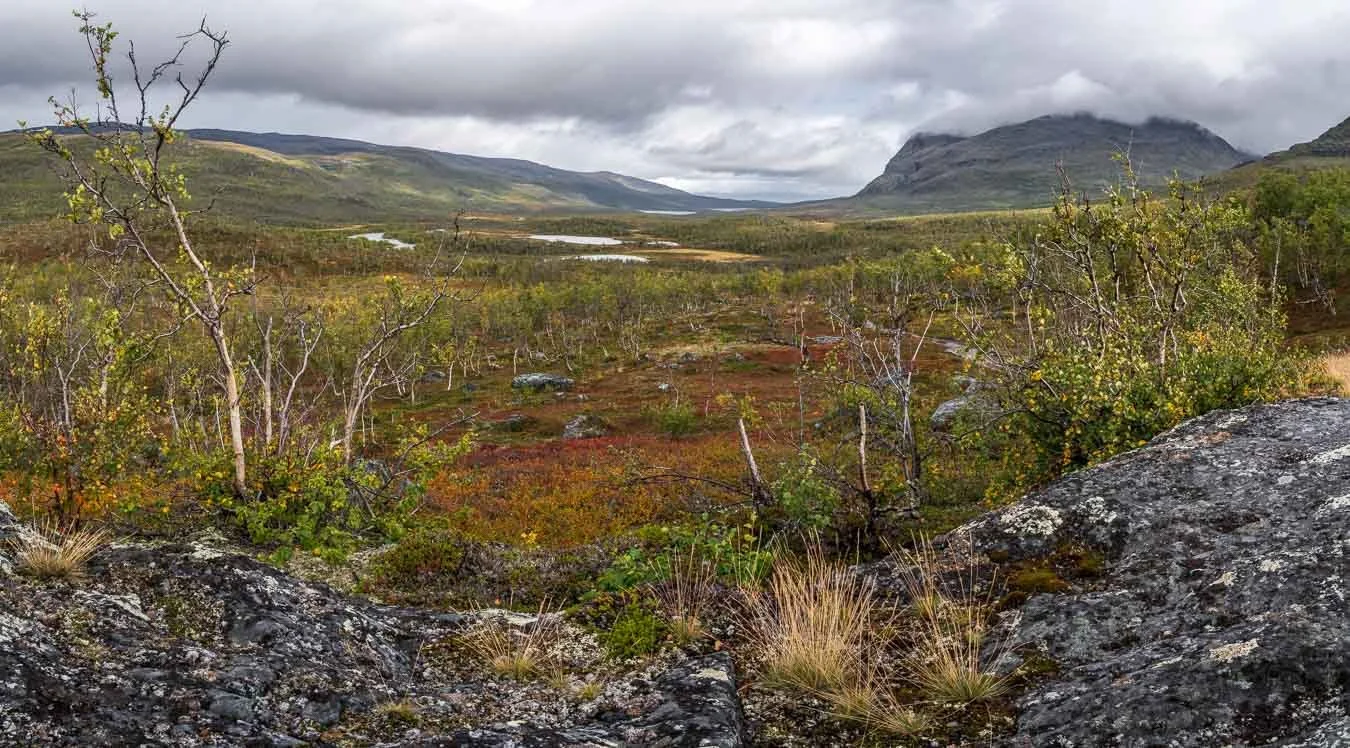
View over Abisko National Park toward STF Abiskojaure.
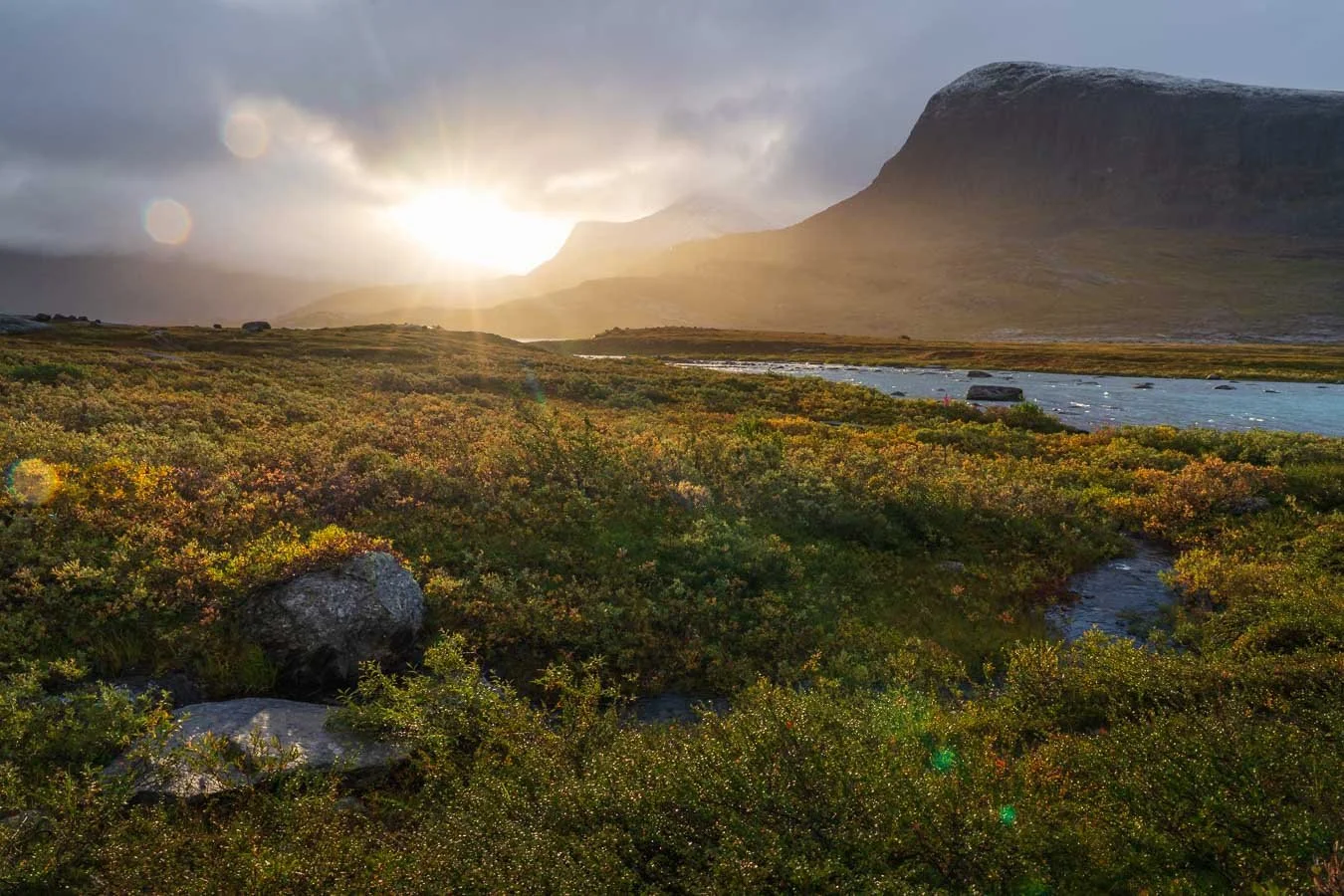
Along the trail you can either stay in STF huts or camp with your own tent. Wild camping gives you flexibility in bad weather or if you simply feel like stopping early at a great spot, but of course you won’t have any facilities. The huts, on the other hand, usually offer bunks, a warm common room, drying areas, and a warden.
Payment for both hut beds and tent spots is made at the warden’s cabin and, in typical Swedish fashion, is designed to be cashless. Many huts also offer optional sauna and shower access for an extra fee. In the main building of each station there is usually a small shop with basic dried and canned food, snacks, and sometimes sodas and beer during the main season. This allows you to either fully resupply on the trail or just treat yourself without having carried all your food from day one. Just remember that you are responsible for carrying your trash out, and double-check the seasonal opening dates before planning to rely on the shops.
If you want the full Scandinavian experience, end your hiking day with a couple of Norrlands Guld beers, followed by a hot sauna and a cold plunge in the lake. You’re likely to share the sauna with (unclothed) Scandinavians doing exactly the same.
One crucial point: the inner sections of the Kungsleden are not accessible by car or bus and mobile reception can be minimal or non-existent. Good planning is essential. If you don’t want to rely on your tent, make sure you have confirmed bookings for all the huts you intend to use, especially in high season, when they can be fully booked. At the southern end of this section, you’ll need a bus from Nikkaluokta back to Kiruna or further north, depending on how you structure your itinerary.
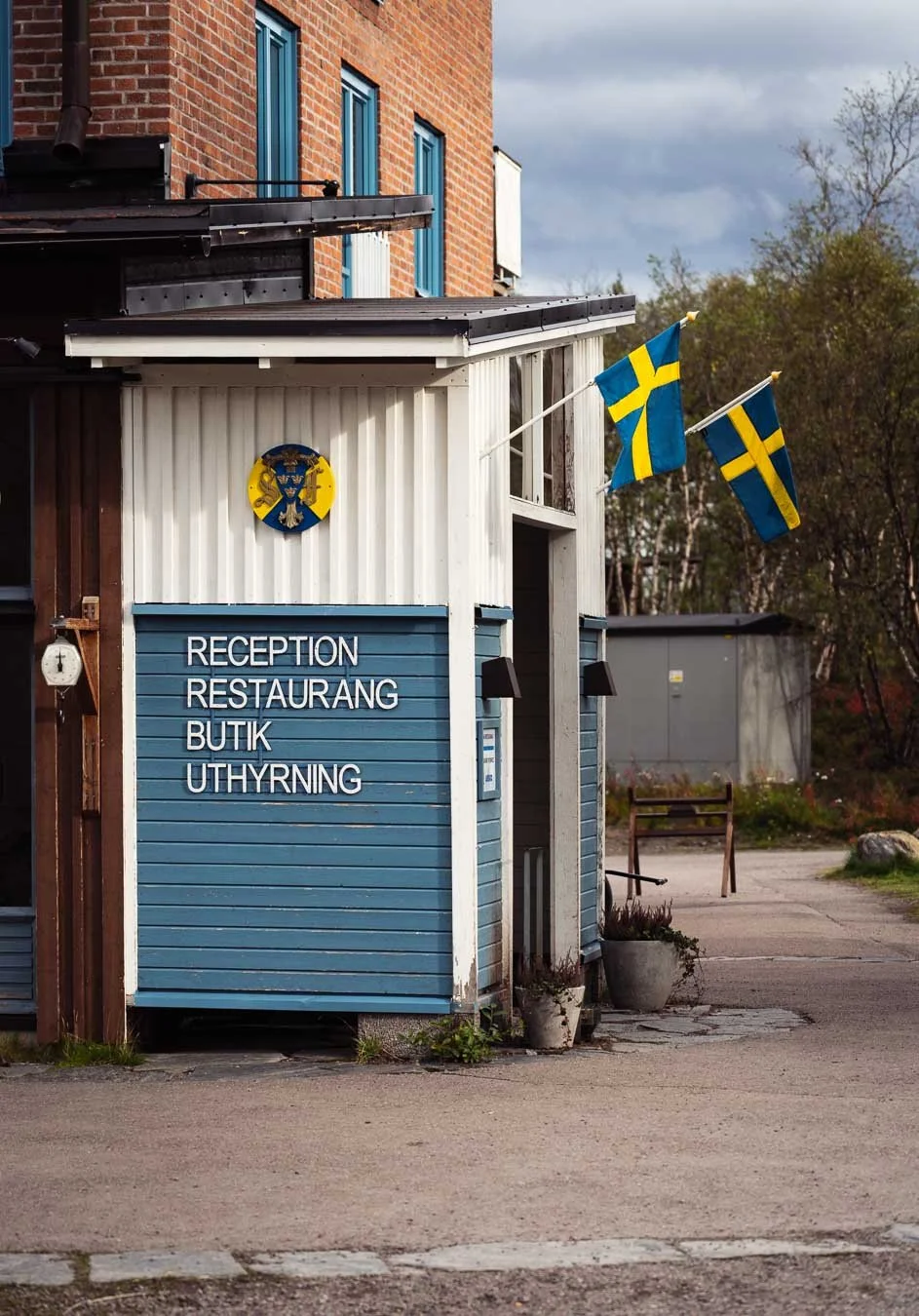
Main entrance of the STF Abisko Turiststation.
If you’re only interested in day hikes in Abisko National Park or you’re visiting in winter, logistics are much simpler. In that case, you can base yourself entirely in or around Abisko. The STF Abisko Turiststation is the classic choice. It offers a hotel with comfortable rooms and mountain views, a hostel for budget-conscious travelers, and several cabins if you prefer more privacy and a rustic feel. There’s usually a lunch buffet or restaurant service and even a pizza place in the basement. It’s also a great place to spend a night or two after finishing the Kungsleden if you hike the trail south-to-north and end in Abisko.
If you combine Abisko with a stay in Kiruna (for flights, dog sledding, or other activities), the town offers a broader range of hotels, hostels, and apartments across different budgets. For something really unusual, consider spending a night at the aforementioned Icehotel in Jukkasjärvi, where you can stay in an ice room (kept below freezing) and/or a warm, insulated room, and pair it with a range of on-site activities.
Best Time to Visit
Abisko is, in principle, a year-round destination. The best time to visit depends entirely on what you want to experience.
If your main goal is to see the northern lights, the darker winter months from roughly December to March are your best bet. Nights are long, the landscape is covered in snow, and extended dawn and dusk periods create very magical lighting conditions. Winter is also the season for dog sledding, ice climbing, snowshoeing, cross-country skiing, and other classic cold-weather activities. Just be prepared for genuinely cold temperatures and limited daylight.
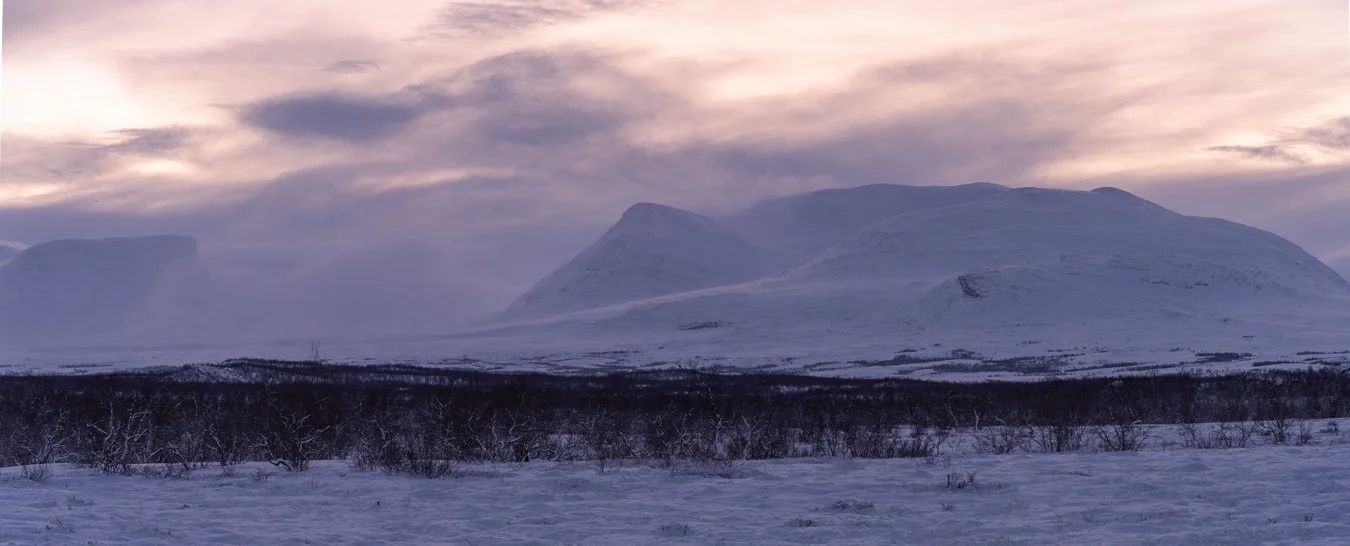
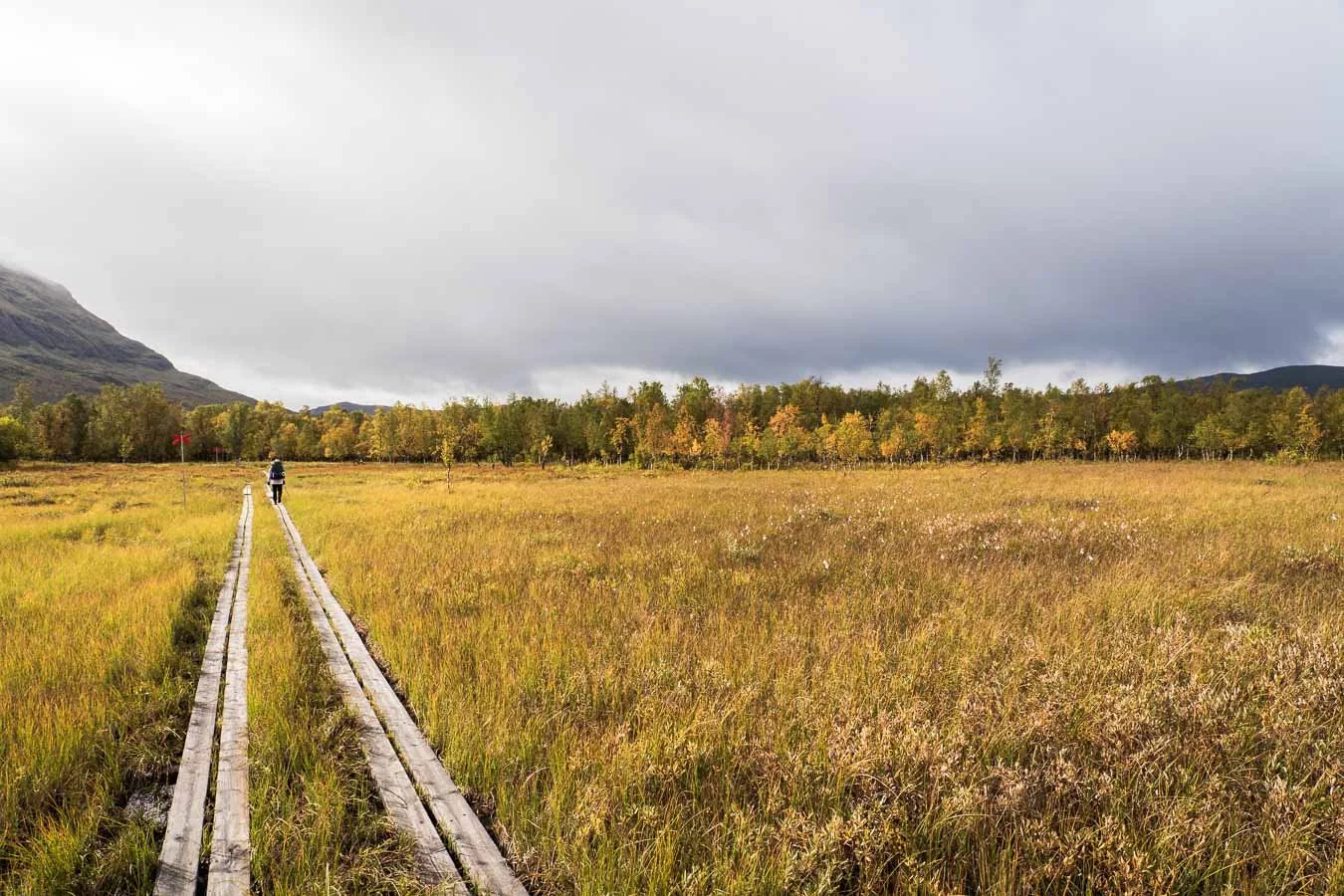
If you want to hike the Kungsleden or enjoy longer day hikes through birch forests, lakes, and more rugged, alpine terrain (than many people typically associate with Sweden), aim for the warmer months from June to August. This is generally the best time to experience the full beauty of the national park and the trail. Be aware that early summer can still bring lingering snowfields and sections of trail flooded by snowmelt. Later in the season, the snow and floods are usually gone, but mosquitoes can be intense in some areas.
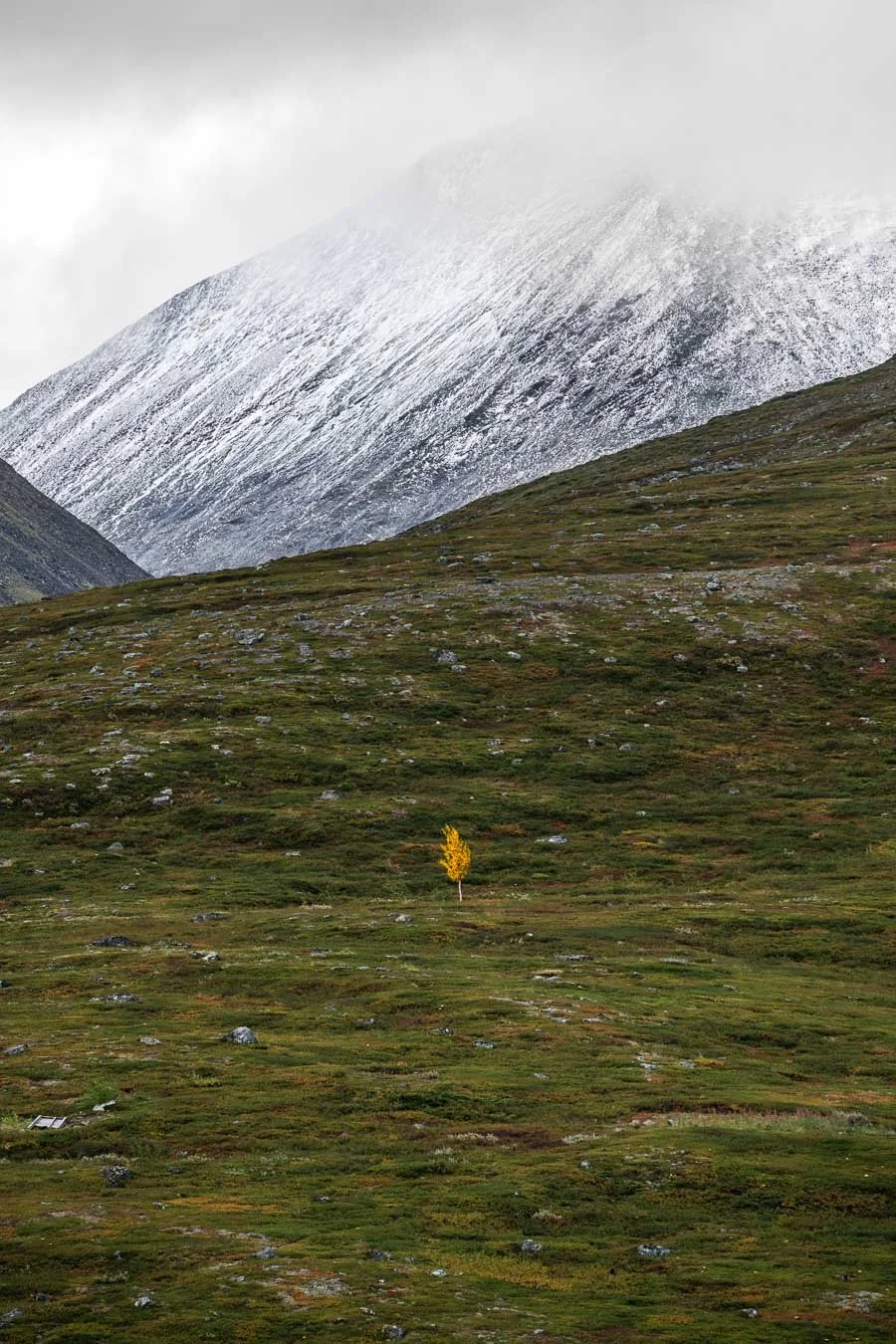
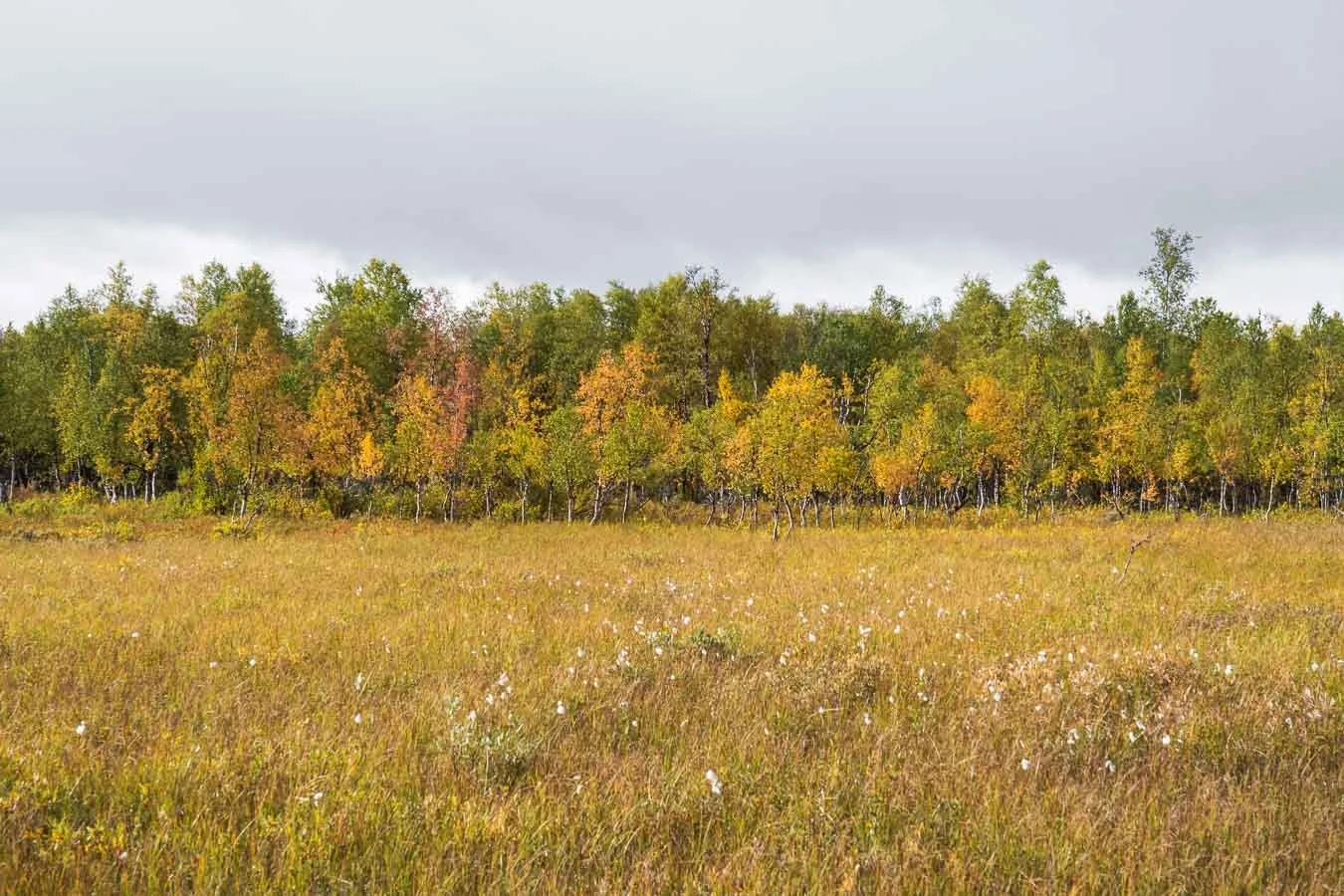
We visited in late summer (early to mid-September) and didn’t encounter any mosquitoes at all. By then, temperatures were already noticeably cooler, but the birch forests were turning their characteristic yellow and gold, which makes the landscape even more spectacular, especially if you’re into photography.
If you don’t mind slightly cooler conditions and want colourful autumn scenery rather than lush green, the shoulder season around early September can be a great compromise. Trails are generally quieter, and the colours are at their best.
For experienced winter travellers, there is also the option of traversing parts of the trail in winter with Nordic backcountry skis or on guided tours. Some dog sledding tours also follow sections of the Kungsleden. This, however, requires more specialised gear, skills, and preparation than a typical summer hike.
Recommendations & Lessons Learned
With a bit of planning – ideally not at the last minute – a trip to Sweden’s far north around Abisko (and nearby Kiruna) in both summer and winter can be an unforgettable experience. Below are a few practical lessons learned that can make your trip smoother and help you avoid unpleasant surprises.
Summer: Day Hikes and Kungsleden
If you’re just doing day hikes in Abisko National Park, you don’t need expedition-level gear, but you still need to treat it as a proper mountain environment. Even in summer it can be cold, wet, and windy.
For casual summer hiking around Abisko:
Bring solid hiking shoes or boots.
Pack proper layers: a fleece or light insulated jacket plus a waterproof shell.
Add a hat and gloves if you tend to get cold easily.
Hiking poles are useful if you plan longer day hikes with more elevation.
Mosquito protection (repellent and/or a head net) can be worth it in midsummer.
Close to Abisko you will usually still have mobile reception, so you’re not completely cut off as long as you stay near the village and main trails.
Once you step onto the Kungsleden and move away from Abisko, that changes. At some point you will lose reception, and large parts of the trail are not accessible by road. That has consequences.
For the Kungsleden section between Abisko and Nikkaluokta:
Carry an offline map (paper map and/or map app with downloaded tiles).
Consider a satellite communicator if you want a safety line to family, friends, or emergency services.
Treat the weather seriously, even in July and August, as it can still be cold, rainy, and very windy. Bring:
Waterproof jacket and trousers
Fast-drying base layers
Warm mid-layers (fleece, light down or synthetic jacket)
Hat, buff, gloves (ideally with spares, if you have room)
Proper boots that can handle wet ground for several days
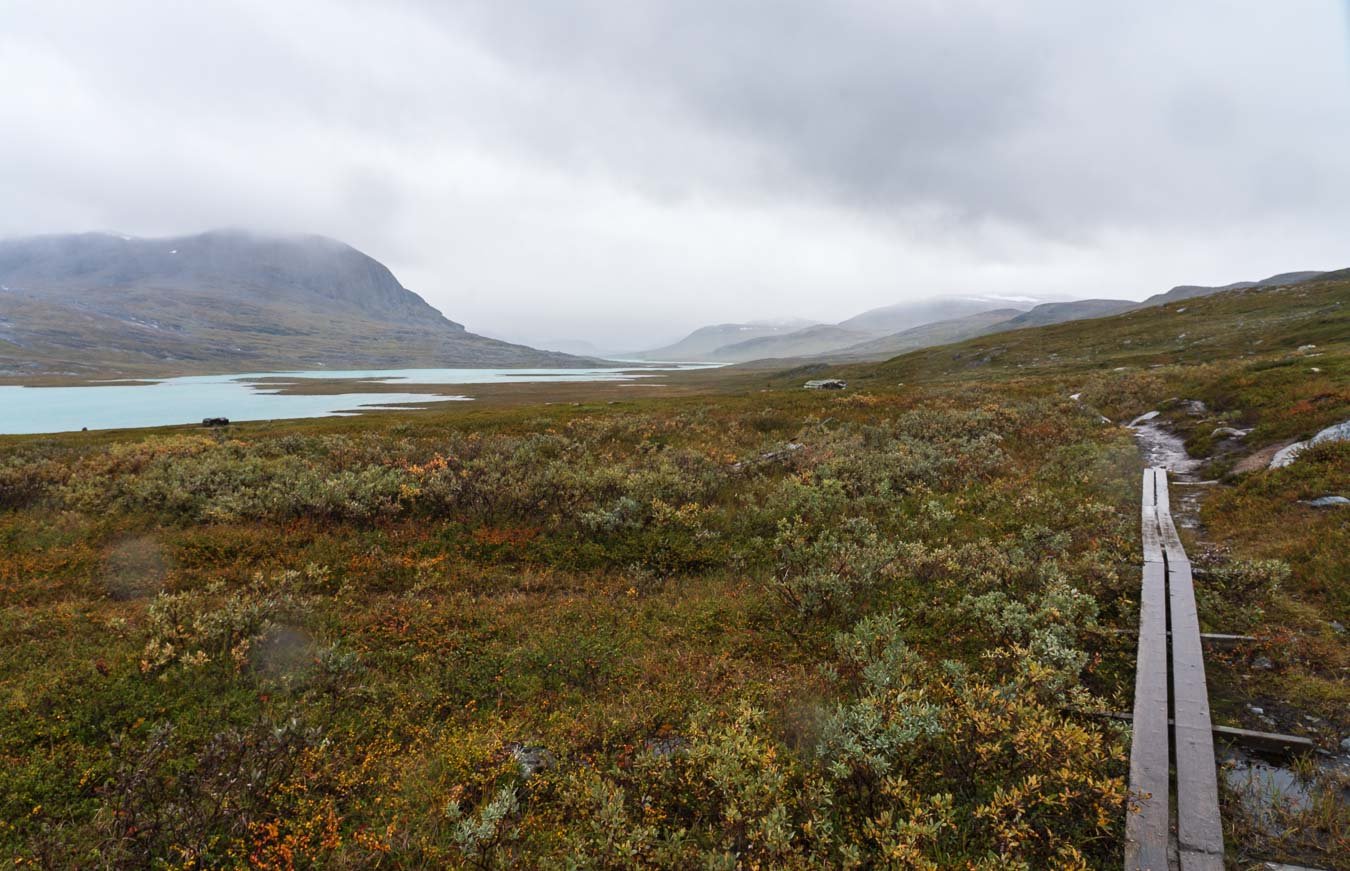
Weather conditions here can change rapidly. Moreover, heavy rain or early‑season snowmelt may leave sections of the Kungsleden trail waterlogged.
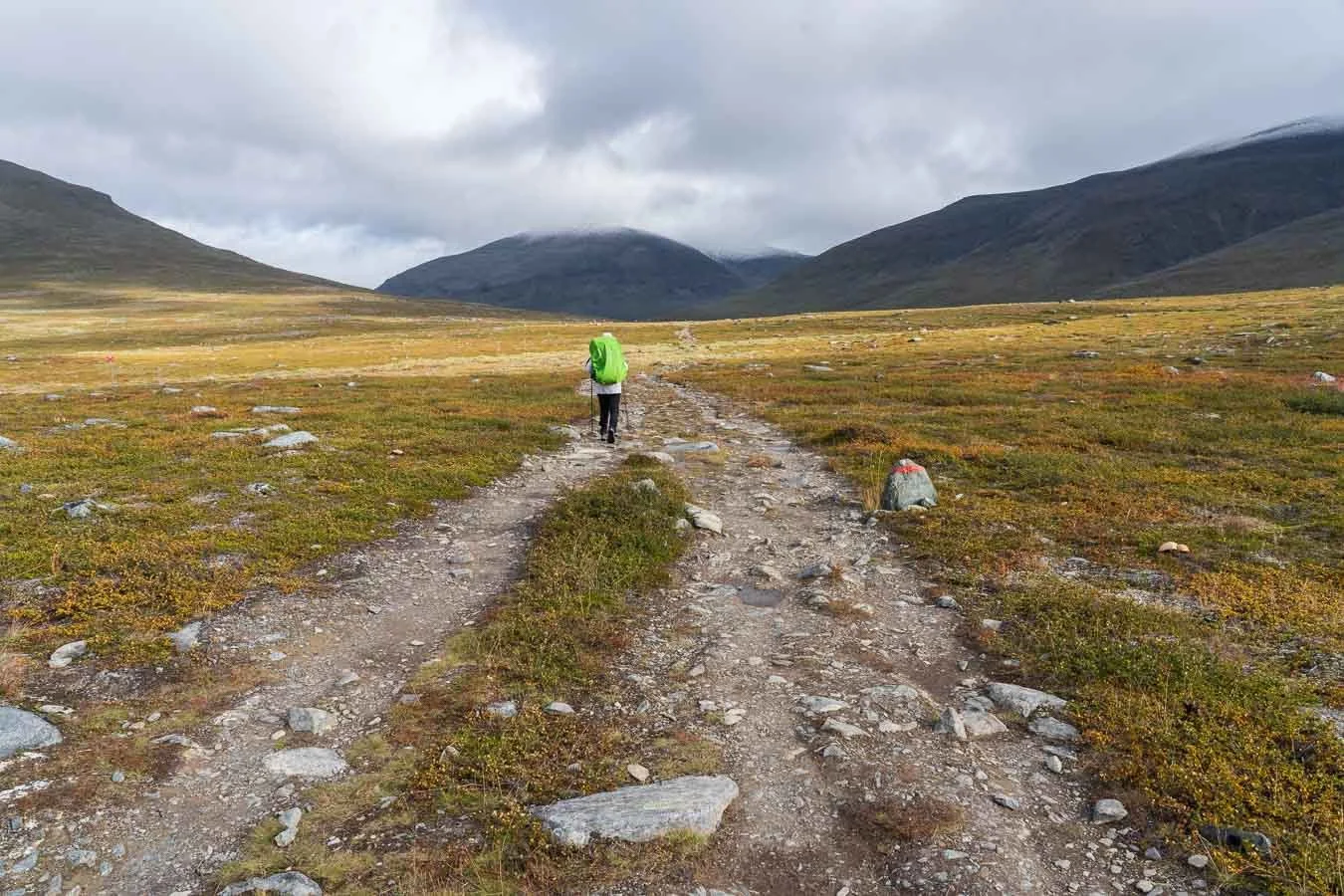
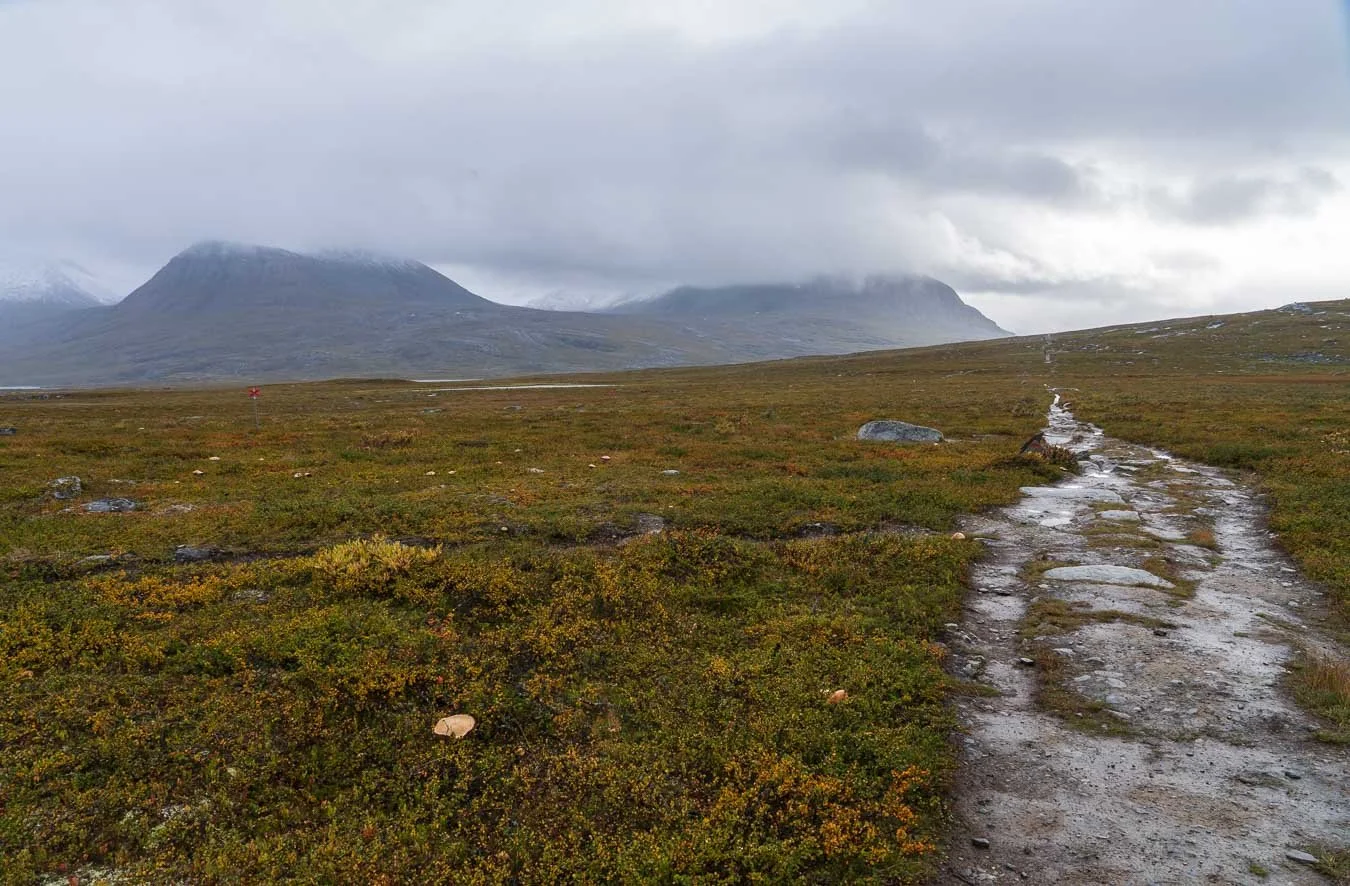
The terrain itself is not extreme in terms of technical difficulty or altitude, but it is nonetheless a multi-day, 100+ km trek. Once you are a few days in, ‘bailing out’ is not really possible. Some experience with multi-day hiking and camping helps a lot, especially if you plan to sleep in a tent the entire time.
Food and hut logistics:
In high season, STF huts are staffed and usually sell basic dried and canned food, snacks, and drinks. You can through-hike without carrying every single meal from the start, but you still need to plan.
In shoulder or off-season, huts may be closed or unstaffed, and shops will not operate. In that case you must be self-sufficient. Check hut opening dates before you commit.
If you want to go light and rely on huts instead of tent + sleeping mat + sleeping bag, book your bunks well in advance. Huts are often full in high season, and you pay a clear premium compared to camping.
On trail, you pay the warden for hut beds or tent spots, often cashless. Saunas and showers in some huts can usually be added on top.
A few practical hiking notes:
Many people recommend hiking this section south to north (Nikkaluokta → Abisko) because prevailing winds often come from the south, so you get more of a tailwind.
There are boat shortcuts in season, for example near Alesjaure and between Kebnekaise and Nikkaluokta. They can save time and energy but only operate in high season and in reasonable weather. For example, on our trip, the boat to STF Alesjaure wasn’t running due to stormy conditions, so don’t rely on them as guaranteed.
Winter: Cold, Auroras, and Activities
Since Abisko lies well above the Arctic Circle, winter conditions shouldn’t be underestimated. Temperatures around –20 °C are common, which can feel especially harsh at night or when you’re standing still to watch the aurora. Thus, proper winter clothing is essential.
For aurora hunting, ice climbing, and dog sledding, consider the following aspects:
Think in layers: thermal base layers, warm mid-layers, and a serious insulated jacket on top.
Use insulated trousers or wear thermal tights under your outer pants.
Warm hat, buff or scarf, and proper winter gloves or mittens are essential.
For ice climbing, bring thick climbing/ski gloves; your hands cool down very fast when gripping ice tools.
For dog sledding, bring a scarf or buff to cover your face. The combination of speed and wind can significantly increase wind chill, especially on exposed skin like your cheeks and nose.
When we went down to the Absiko River Delta to watch the northern lights, even with several layers, it became uncomfortable after roughly an hour of standing still. Chemical hand and foot warmers made a noticeable difference and are absolutely worth packing!
Guided aurora tours with a car or minibus are less harsh because you can warm up between viewing sessions, but even then you need a solid clothing system. Operators may provide an outer layer (snowsuit, boots), but you should still bring warm base and mid-layers. Check what’s included with your operator in advance.
Dog sledding around Abisko is limited in capacity. Tours can sell out quickly, especially in peak season. Either book in advance in Abisko or look at operators around Kiruna, many of whom offer transfer from your accommodation.
Transport between Abisko and Kiruna in winter
Despite looking close on the map, Abisko and Kiruna aren’t that well connected, especially if you want flexibility. Options are:
Train: limited departures on long-distance services that stop in both Kiruna and Abisko.
Public bus: Länstrafiken Norrbotten line 91 runs seasonally with limited capacity and departures.
Transfers: private shuttles/airport transfers (higher price, limited seats).
Important: trains between Kiruna and Abisko can sell out. If a departure is fully booked, you may be refused boarding due to limited capacity, even if the ride is short. Book this leg in advance if your itinerary depends on it.
If train seats are gone or the times don’t work for you, look for shuttle buses or private transfers between the towns. They are often used in connection with activities (e.g. dog sledding) and can be a fast, though pricier, option. Again, capacity is limited, so don’t leave it to the last minute if you have fixed onward travel.
Aurora expectations
Abisko is one of the most reliable places in the world for seeing northern lights, but that still doesn’t mean any kind of guarantee. You need three things at the same time:
Sufficient geomagnetic activity (high enough KP-index)
Clear or at least partly clear skies
You being outside and paying attention at the right time. Moreover, be ware that in low-light situation your vision shifts toward rod cells (as opposed to cone cells in bright light), which are sensitive to faint light but poor at color. Consequently, weaker auroras often look like pale, greyish ‘cloud bands’ to the naked eye and only show clear green (or purple) in photos. If you suspect an aurora, point your phone/camera at it and take a photo. The color and structure usually become more obvious in the image, which should help with identifying one!
Cloud cover can ruin an otherwise strong forecast, and a high KP won’t help if you miss the active window. Guided tours and the Aurora Sky Station can improve your odds because guides track the forecasts and often know where cloud gaps are most likely - but of course you pay for that advantage and give up some flexibility.
Kiruna as an add-on
We only ended up flying to Kiruna because all train tickets from Uppsala to Abisko had sold out, forcing us to use the airport instead. In hindsight, we don’t regret that additional, short stay in Kiruna at all.
Abisko National Park is the clear winner in terms of scenery, but Kiruna still has its own appeal. Most notably:
The distinctive wooden church and bell tower
The history and present-day reality of the iron ore mine and the ongoing relocation of the town
Similar winter activities to Abisko, but often with higher capacity (dog sledding, snowmobiling, aurora tours)
Easy access to unique places like the Icehotel in Jukkasjärvi
If time and budget allow, treating Kiruna as more than just a transit point is worthwhile. It adds a cultural and historical layer that complements the wilderness focus of Abisko.
Conclusion
Abisko, and the national park of the same name, is an outstanding destination if you want to venture north of the Arctic Circle and experience the very top of Swedish Lapland. It can be visited year-round and easily justifies seeing it at least twice: once in the warmer months and once in deep winter, when the contrast between seasons is at its strongest.
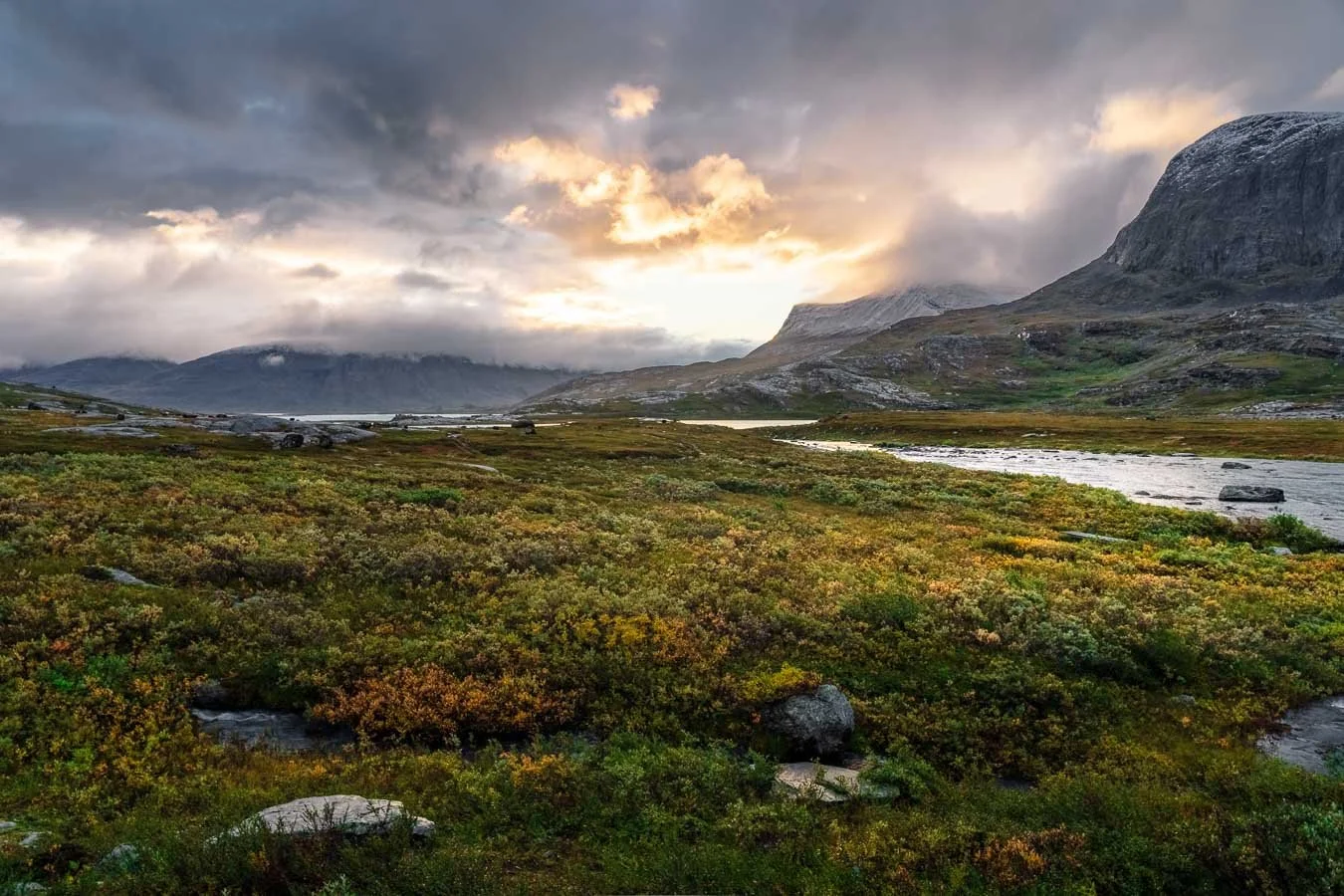
In summer and into early autumn, the area is defined by lush mountain birch forests, clear alpine lakes and rivers, and low shrubs and heather above the treeline. This variety of landscapes can be experienced on shorter day hikes around Abisko or more fully by setting out on the Kungsleden, one of Scandinavia’s most popular long-distance trails.
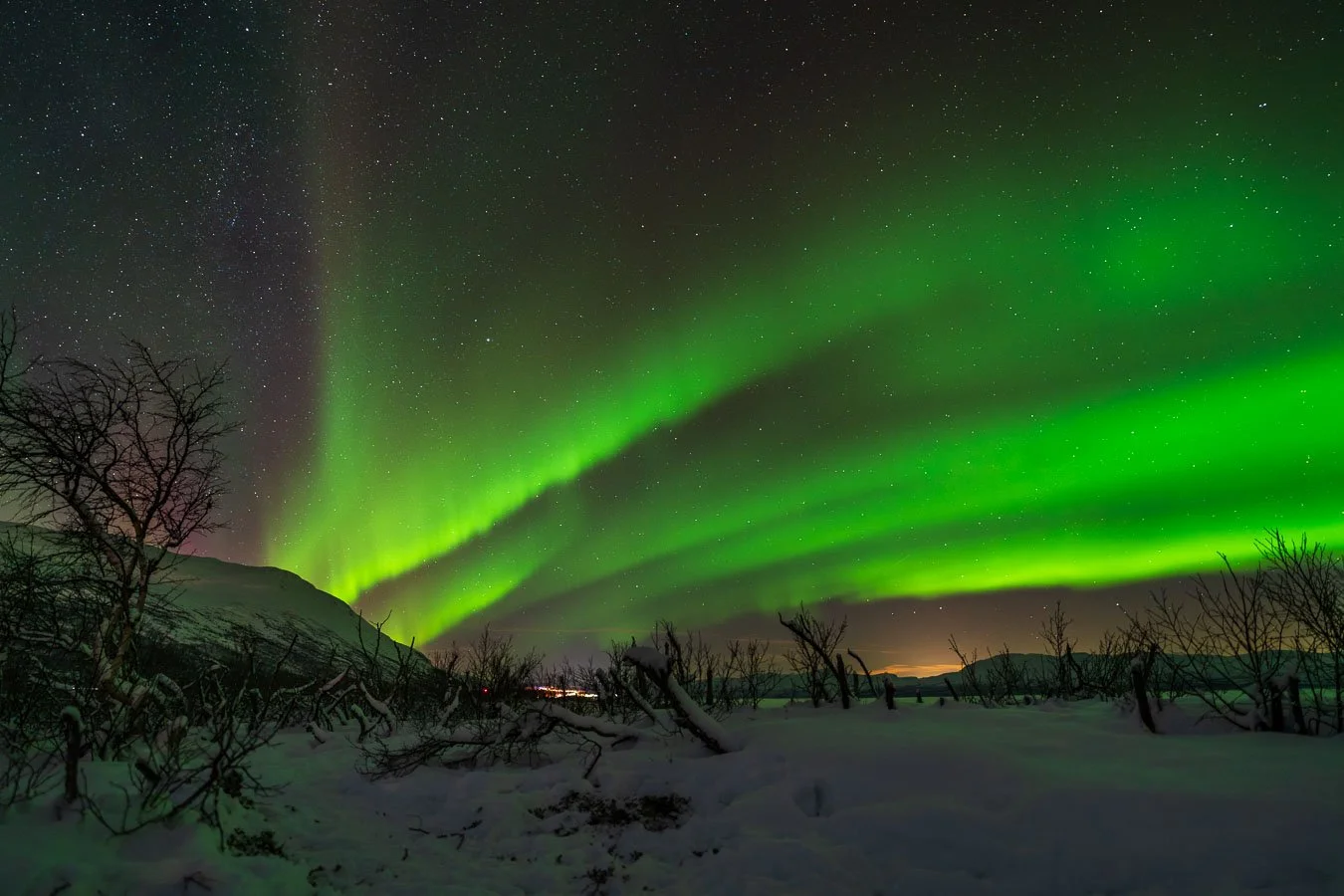
In winter, Abisko becomes a prime destination despite – or because of – the cold and limited daylight. Long nights and frequent clear skies make it one of the best places in the world to see the northern lights. At the same time, there is a wide range of winter activities, such as dog sledding, ice climbing, snowshoe hikes, cross-country skiing, and more. Nearby Kiruna adds further interest with its distinctive wooden church, the vast iron ore mine that shaped the town, and unique nearby sights such as the Icehotel in Jukkasjärvi.
Whether your preference leans toward long, bright summer days or crisp, dark winter nights, Abisko (and Kiruna) offer landscapes and experiences that stand out. The combination of dramatic nature and a small, welcoming community makes this corner of Swedish Lapland a place that stays with you long after you leave.
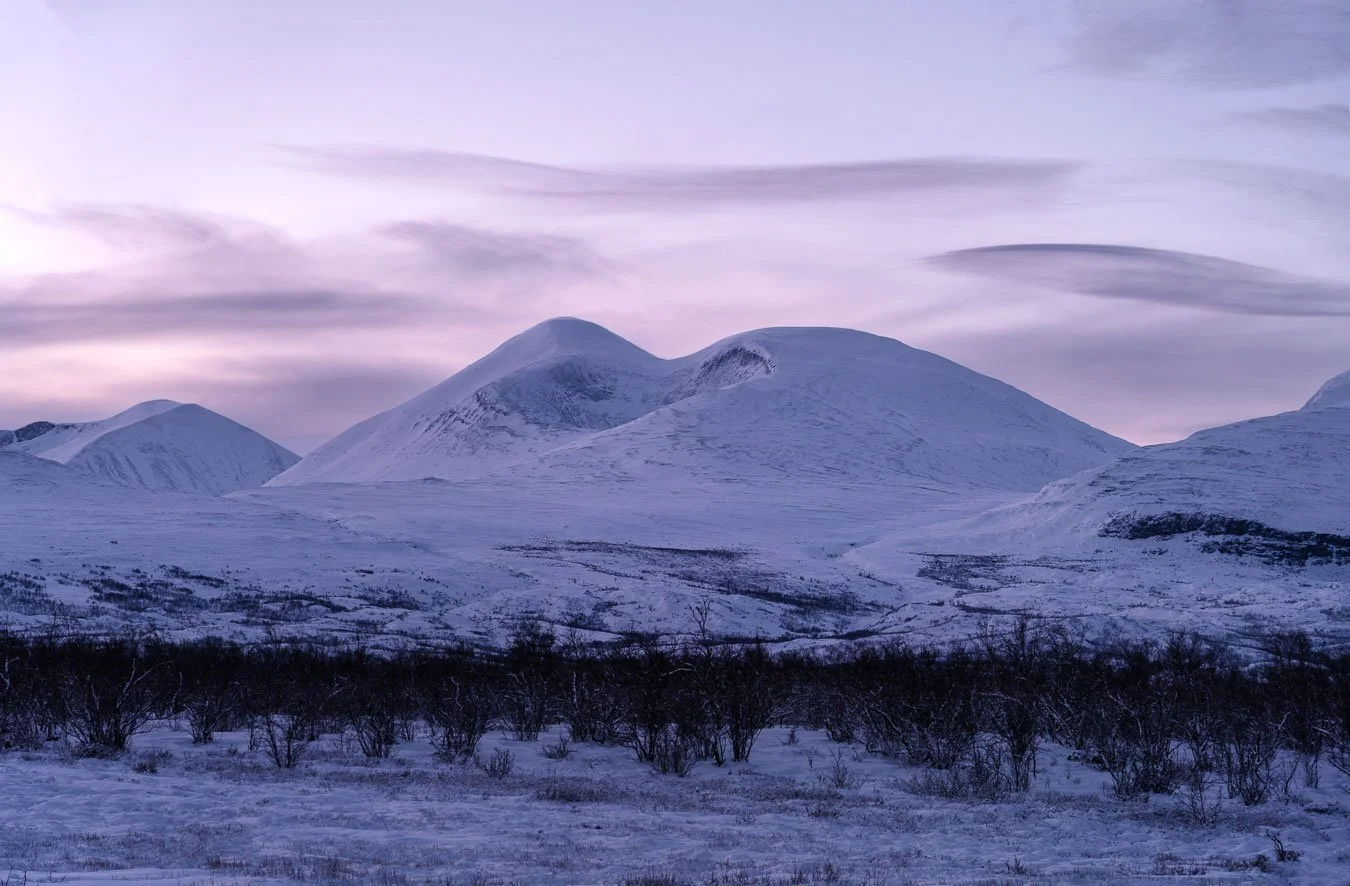
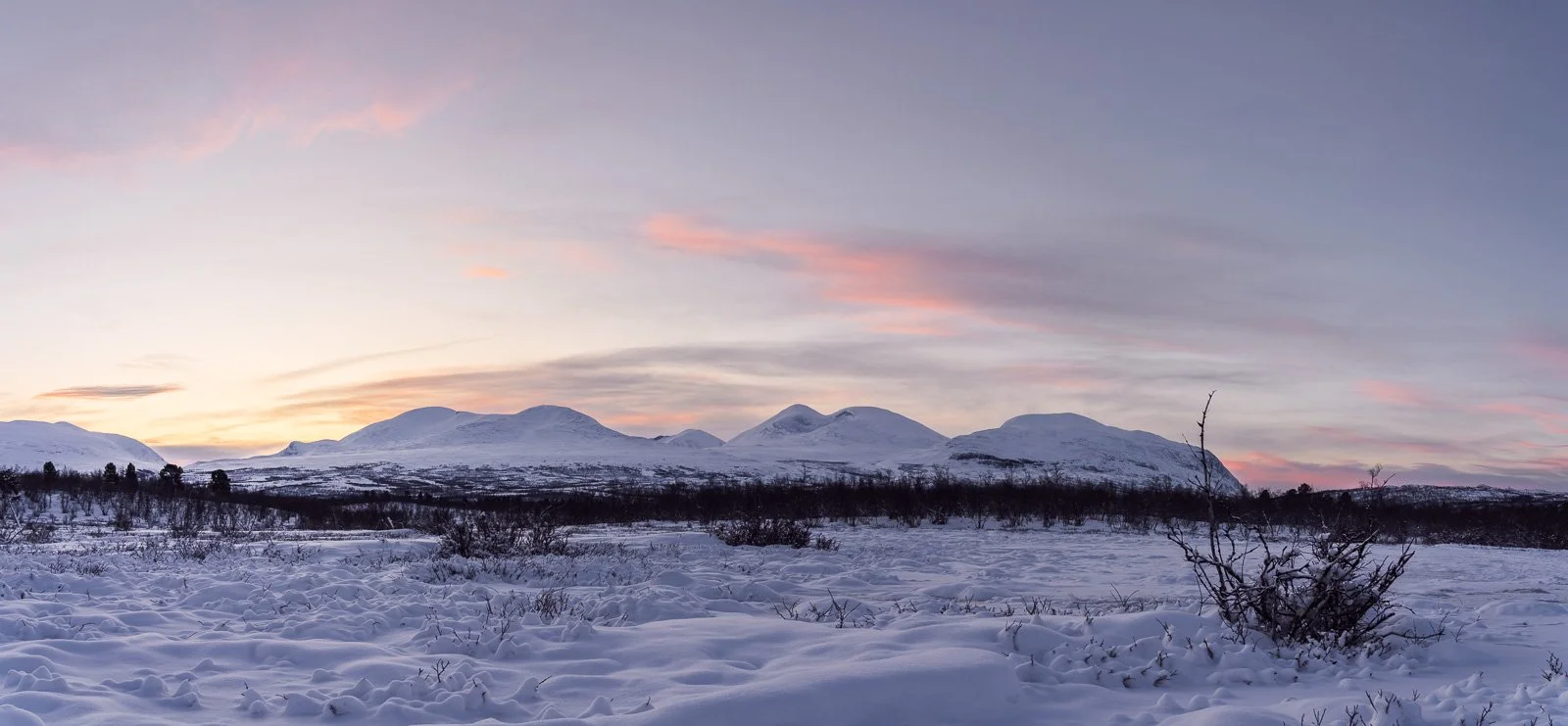
The soft, beautiful lighting during the extended dusk and dawn hours of winter at these northern latitudes (such as in Abisko National Park) often leads to magical winter scenes like this.
Additional Content
Time lapse of vivid northern lights over Lake Torneträsk in Abisko National Park (click here to go back up).
Useful Links
Here are some links and resources to assist you in planning your own adventure above the Arctic Circle around Abisko!
General Links
Abisko National Park Information
Physical/Digital Maps (recommended by STF)
Alternatively, use apps like ‘Norrbottens Naturkarta’ (Android/iOS) or AllTrails etc. (just make sure the map area is downloaded for offline use)
Abisko National Park – General Information
Abisko National Park – Safety & Rules
Transportation
Public Bus Information (Kiruna - Abisko, seasonal/limited)
Overnight Train (SJ Train) Information
Other Links
Map
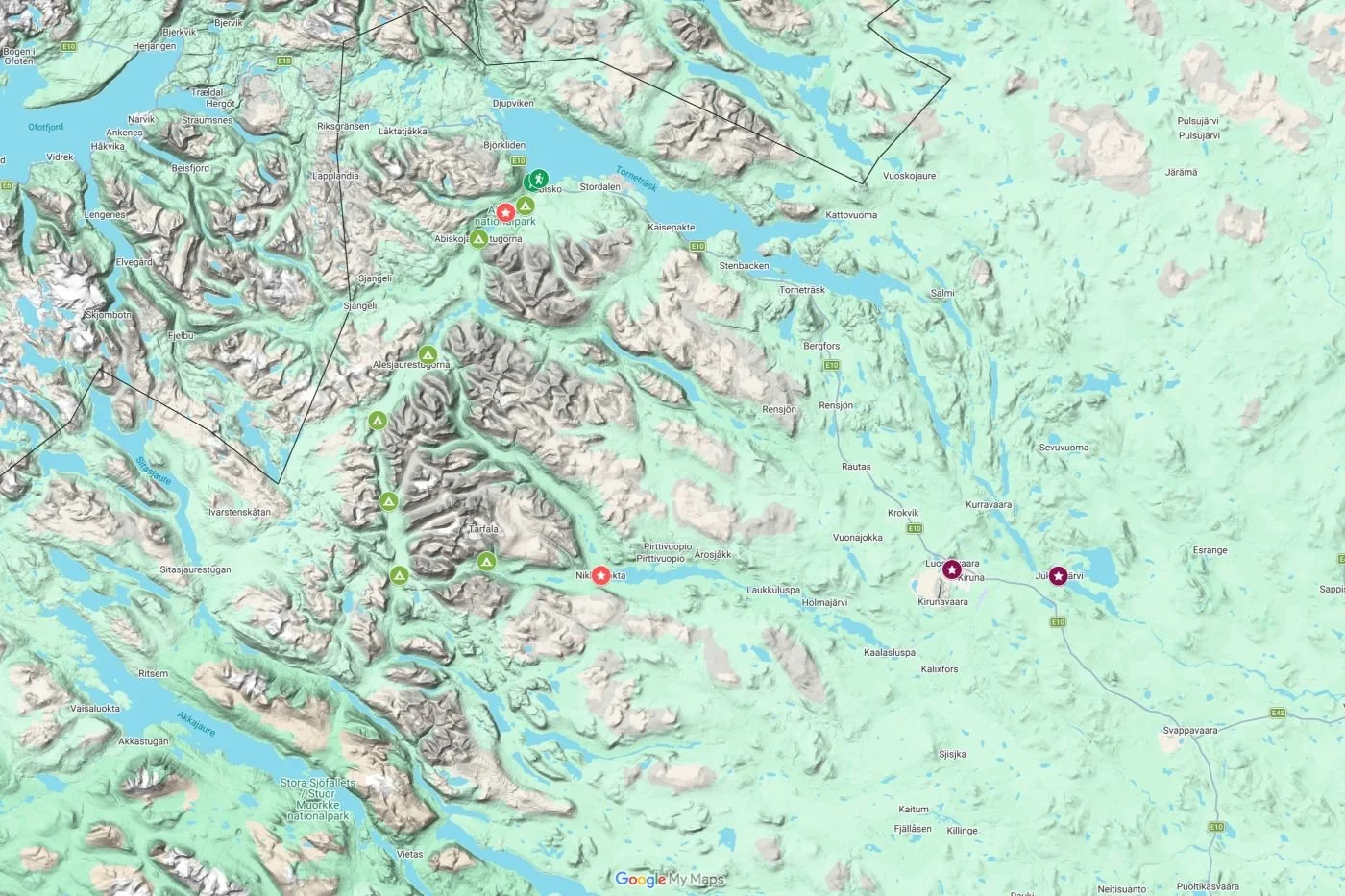
For the best viewing experience, exploring this website on a desktop browser is recommended.
Due to the large number of featured photos, the images are somewhat compressed. For higher-quality versions of selected pictures, visit the photo gallery!
If you enjoyed this blog post and want to see more content beyond Swedish Lapland, explore the blog posts from other journeys around the world!
And in case you have more questions about the itinerary or anything else, feel free to get in touch here!